

Managed XDR: Detect, Contain, and Respond Before Damage Spreads
15-minute response SLA. 99.9% uptime. Live in 72 hours. Built on Microsoft Sentinel and Defender XDR.
MXDR go-live
Response SLA
Uptime SLA
Analyst coverage
Your Tools Are Alerting. Your Business Is Still at Risk.
The average organisation takes 194 days to detect a breach and another 64 days to contain it. By then, the damage is done. (IBM Cost of a Data Breach, 2024)
Most businesses already have security tools in place. The challenge is separating real threats from constant alert noise and responding before attackers move deeper into the environment.
Attackers rarely stay in one place. They move from email to identity, cloud, and endpoints, exploiting gaps between systems that are monitored separately. Without continuous monitoring and investigation, these threats can remain undetected for weeks before reaching critical systems.
Managed XDR closes that gap.
What is Managed XDR or MXDR?
Managed XDR, or Managed Extended Detection and Response, is a managed security service that detects and responds to threats across endpoints, email, identity, cloud, and networks.
Unlike standalone security tools, MXDR combines automated detection with expert analysts for real-time investigation and response.
CyberQuell’s MXDR service uses Microsoft Sentinel and Microsoft Defender to correlate alerts across your Microsoft 365 and Azure environment, enabling faster detection and complete threat visibility.
MXDR vs MDR vs XDR vs In-House SOC: What's the Difference?
If your current setup generates alerts but no one is correlating them across layers and responding at night, on weekends, or during holidays, you have an MDR or XDR tool. You don't have MXDR.
| MDR | XDR | In-House SOC | CyberQuell MXDR | |
|---|---|---|---|---|
| What it is | Managed Detection & Response | Extended Detection & Response (software) | Your own security operations team | Managed XDR: software + 24/7 human response |
| Coverage | Primarily endpoints | Cross-domain correlation | Depends on team capacity | Endpoints, email, identity, cloud apps: all layers |
| Who responds | Provider's analysts | No one alerts go to your team | Your analysts (if available) | CyberQuell analysts, 24/7/365 |
| Response time | Varies by provider | N/A: no response layer | Depends on staff availability | 15-minute SLA on critical alerts |
| What's missing | Email and identity often excluded | No managed response layer | Expensive, 5+ hires for 24/7 coverage | Nothing: this is the complete solution |
What's Included in CyberQuell MXDR
No ambiguity about what you're buying. Here's the full scope:

24/7/365 Threat Monitoring
Eyes on your environment every hour of every day, including holidays and weekends

Microsoft Sentinel SIEM
Centralized log ingestion and correlation across your full Microsoft 365 and Azure environment

Microsoft Defender XDR
Unified cross-domain detection covering endpoints, email, identity, and cloud applications

AI-assisted alert triage
Automated filtering reduces noise so analysts focus on real threats, not false positives

Proactive threat hunting
Analysts investigate anomalies before alerts fire, catching threats in early stages

Rapid Incident Containment
Immediate isolation and neutralization of active threats to prevent lateral movement

Forensic Root Cause Analysis
Every confirmed incident includes a full investigation: how it entered, how far it spread, what it touched.

MITRE ATT&CK-Mapped Reporting
Incident reports tied to the industry-standard attack framework so your team understands exactly what happened

15-Minute Critical Alert Response SLA
Guaranteed acknowledgment and action on critical threats around the clock
15-minute response SLA. $150,000+ in fraud prevented for a single client. Zero financial loss.
Start Protecting Your Business This Week
Your environment could be monitored by Friday. No hardware. No long-term contract on the pilot. No waiting months for an internal team to come online.


Hear from our clients
How CyberQuell MXDR Works: From Signed Contract to Active Protection in 72 Hours
From initial assessment to 24/7 threat monitoring and response, CyberQuell MXDR gets your environment protected in as little as 72 hours.
Security Assessment (Day 1)
We assess your environment, security tools, identity systems, cloud infrastructure, and compliance requirements to identify critical risks and monitoring priorities.
Deploy and Integrate (Days 2–3)
We deploy Microsoft Sentinel and Defender XDR, configure detection rules, and establish behavioural baselines. Most environments are fully operational within 72 hours, with no new hardware required.
Monitor, Detect, and Hunt (Ongoing)
Our analysts monitor your environment 24/7, using AI-driven triage to reduce alert noise, investigate threats, and proactively hunt for indicators of compromise.
Respond, Contain, and Report (When It Matters)
Our analysts monitor your environment 24/7, using AI-driven triage to reduce alert noise, investigate threats, and proactively hunt for indicators of compromise.
Who Needs Managed XDR?

Financial Services and Fintech
Payment data, client accounts, and wire transfer workflows make financial organizations among the most targeted sectors globally.
A single compromised credential can expose ACH systems, client records, and regulatory filings simultaneously. MXDR gives you the detection depth and audit trail required for SOC 2 and PCI DSS compliance, without building the team internally.

Healthcare & Life Sciences
HIPAA mandates administrative, physical, and technical safeguards, including audit controls and activity monitoring.
Most breaches in healthcare start with phishing, not malware. CyberQuell MXDR covers email, identity, and cloud simultaneously, providing the continuous monitoring HIPAA requires and the response speed patient safety demands.

SaaS and Cloud-Native Companies
Your attack surface is distributed: remote workers, SaaS applications, cloud infrastructure, and endpoints across multiple regions.
Monitoring them in isolation leaves gaps attackers exploit. MXDR correlates activity across every layer so a suspicious login attempt in one service connects to a file access in another before either becomes a breach.

Mid-Market Teams Without a Full SOC
Building 24/7 in-house security coverage means hiring five or more analysts, investing in SIEM infrastructure, and developing detection playbooks.
First-year cost typically exceeds $300,000, and you still need nights, weekends, and holidays covered. CyberQuell MXDR delivers the equivalent of a full security operations center for a fraction of the cost, with no hiring, no infrastructure, and no ramp-up period.
Case Studies
See how these played out

Case Study
Emergency M365 Defederation | Legal Firm / 200 Mailboxes | Zero Email Downtime
A 200-mailbox law firm was locked inside GoDaddy's Microsoft 365 tenant, unable to reach the E3 security features their client-confidentiality obligations demanded.CyberQuell executed a full tenant defederation in four hours with zero email downtime, handing the firm complete administrative control and unlocking encryption, Conditional Access, and data loss prevention.
Engagement duration: 4 hours | Environment: 200 mailboxes | Email downtime: Zero | E3 security features unlocked: Yes
Case Study
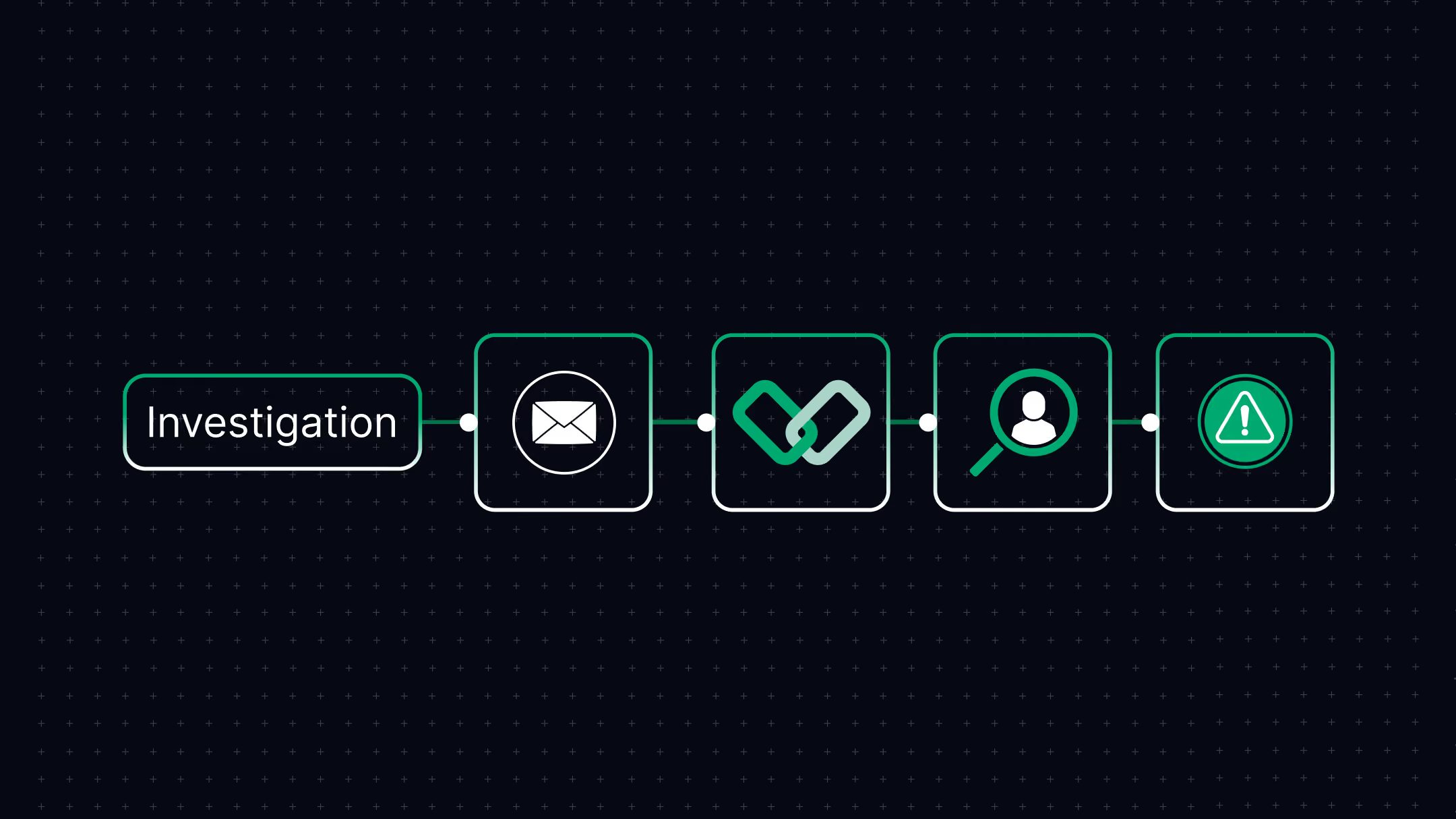
BEC Payment Redirect | Events / Exhibitor | No Internal Breach
A fraudulent invoice using domain impersonation redirected a $5,562.50 exhibitor booth deposit to an attacker-controlled account.CyberQuell's investigation confirmed no internal breach had occurred, avoiding costly tenant-wide remediation and documenting the incident for financial and insurance claims.
Incident type: Business Email Compromise | Payment redirected: $5,562.50 | Attack method: Domain impersonation | Systems compromised: None
Case Study
Multi-Phase BEC Campaign | Professional Services | $150,000+ Fraud Attempt Stopped
A sophisticated threat actor maintained persistent access to a bookkeeper's Microsoft 365 mailbox for four months, survived multiple remediation attempts, and orchestrated fraudulent payment requests to multiple clients totalling over $150,000.
CyberQuell's forensic investigation uncovered session token theft and malicious Outlook rules that had survived credential resets. Full threat eradication. Zero financial loss.
Attack duration: 4 months | Fraud attempted: $150,000+ | Financial loss: £0 | Previous remediation attempts failed: Yes

Case Study
Phishing Account Compromise | Microsoft 365 / Azure AD | Contained in Hours
A phishing attack compromised a single Microsoft 365 account, raising the threat of persistent mailbox access and data theft across the tenant.CyberQuell contained the account within hours, confirmed only a handful of emails were accessed, and verified no persistence mechanisms or data exfiltration remained.
Incident type: Phishing compromise | Environment: Microsoft 365 / Azure AD | Systems compromised: Single user account | Data exfiltration: None
Case Study
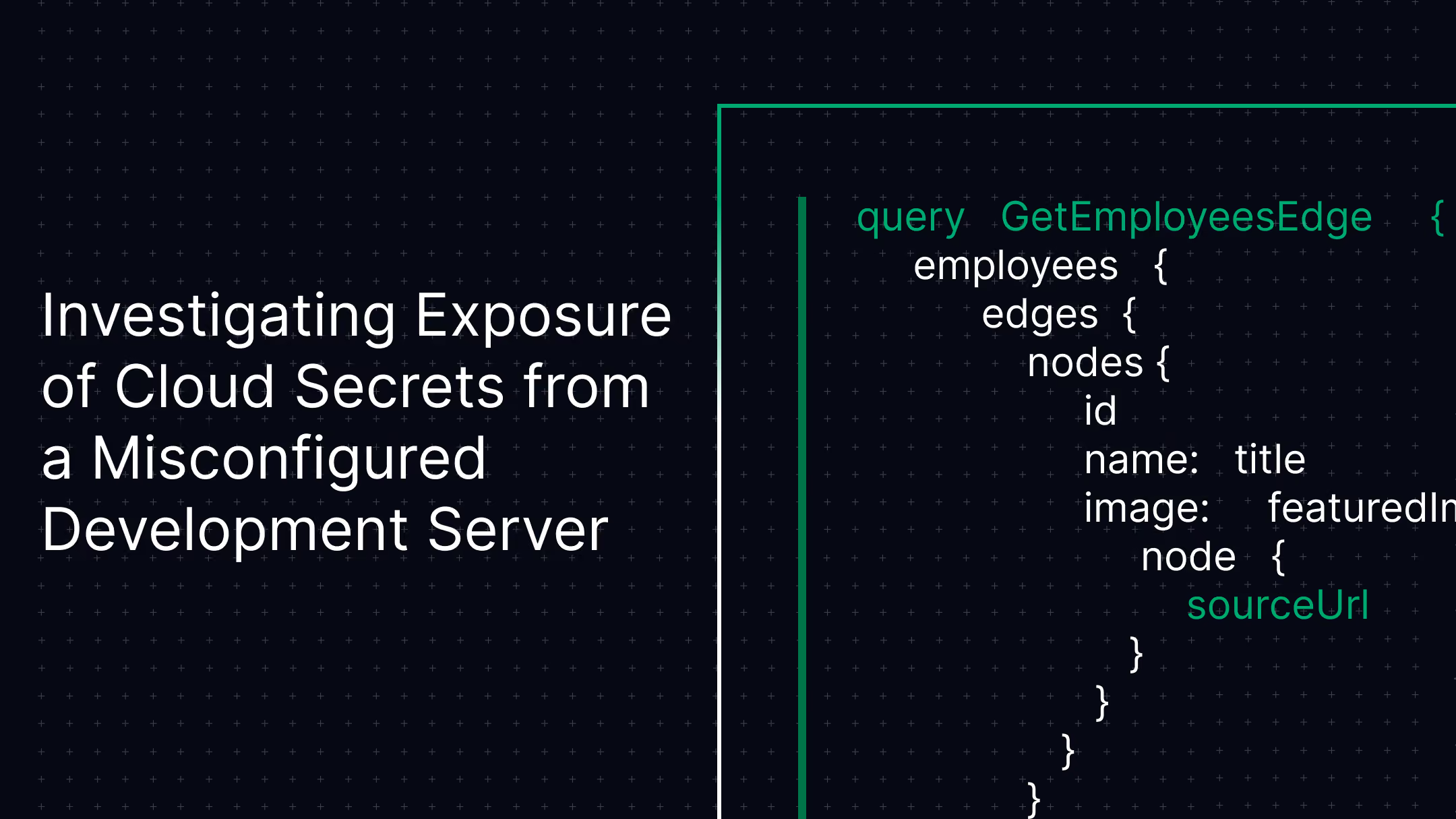
Exposed Cloud Secrets | AWS / Web Application | No Unauthorised Access
A misconfigured Symfony development server publicly exposed cloud credentials and application secrets, opening the door to a full AWS environment compromise.CyberQuell's forensic investigation confirmed no unauthorised access had occurred and rotated every exposed credential before it could be abused. Production systems untouched.
Incident type: Cloud secret exposure | Environment: AWS / Symfony | Credentials rotated: Before exploitation | Systems compromised: None

Case Study
Suspicious M365 Logins | Microsoft 365 / Azure AD | No Compromise Confirmed
Microsoft 365 security alerts flagged logins from unusual locations, pointing to a possible account takeover across the tenant.CyberQuell traced the anomalies to legitimate network routing behaviour and confirmed no compromise, sparing the organisation disruptive account resets while tightening identity monitoring.
Incident type: Suspicious authentication | Environment: Microsoft 365 / Azure AD | Root cause: Network routing | Systems compromised: None

Case Study
HR Document Exposure | Microsoft 365 / SharePoint | No Breach Confirmed
Confidential HR and compensation documents began surfacing in Microsoft 365 search results, triggering fears of a serious data breach.CyberQuell traced the exposure to permission inheritance and migration errors rather than an external attack, then restricted access and hardened Microsoft 365 governance.
Incident type: Internal data exposure | Environment: SharePoint / OneDrive | Root cause: Permission inheritance | External breach: None
.avif)
Case Study
White-Label SOC Partnership | Managed Service Provider | $12,400 MRR in 23 Days
A regional MSP needed to offer security monitoring to more than 40 SMB clients but had no SOC, no spare capital, and no security staff to build one.CyberQuell launched a fully white-labelled SOC in 23 days with zero capital outlay, generating $12,400 in monthly recurring revenue at 60 percent margins under the MSP's own brand.
Engagement type: White-label SOC | Time to revenue: 23 days | Client portfolio: 40+ SMBs | Capital investment: Zero
MXDR vs MDR vs XDR vs In-House SOC: What's the Difference?
If your current setup generates alerts but no one is correlating them across layers and responding at night, on weekends, or during holidays, you have an MDR or XDR tool. You don't have MXDR.
| What it is | What it does | What it's missing | What it's missing | |
|---|---|---|---|---|
| What it is | Managed Detection & Response | Extended Detection & Response (software) | Your own security operations team | Managed XDR: software + 24/7 human response |
| Coverage | Primarily endpoints | Cross-domain correlation | Depends on team capacity | Endpoints, email, identity, cloud apps: all layers |
| Who responds | Provider's analysts | No one alerts go to your team | Your analysts (if available) | CyberQuell analysts, 24/7/365 |
| Response time | Varies by provider | N/A: no response layer | Depends on staff availability | 15-minute SLA on critical alerts |
| What's missing | Email and identity often excluded | No managed response layer | Expensive, 5+ hires for 24/7 coverage | Nothing: this is the complete solution |
Our Certifications
We pride ourselves on having a highly certified team, with each member continuously upgrading their skills to stay at the forefront of cybersecurity.



15-minute response SLA. $150,000+ in fraud prevented for a single client. Zero financial loss.
Start Protecting Your Business This Week
Your environment could be monitored by Friday. No hardware. No long-term contract on the pilot. No waiting months for an internal team to come online.
Frequently Asked Questions About Managed XDR
Find answers to commonly asked questions about our cybersecurity solutions and services.
MDR (Managed Detection and Response) typically focuses on endpoints and network traffic. Managed XDR extends that coverage to every layer of your environment: email, identity, cloud applications, and endpoints simultaneously. The difference matters because modern attacks rarely stay in one layer. An attacker who enters through a phishing email will move to identity, then cloud, then endpoint, and MDR tools often miss the lateral movement between layers. MXDR correlates activity across all of them and responds at every stage.
Our MXDR service covers your full Microsoft 365 and Azure environment: endpoints via Defender for Endpoint, email via Defender for Office 365, identity via Azure Active Directory monitoring, cloud applications via Defender for Cloud Apps, and centralized correlation via Microsoft Sentinel SIEM. If your business runs on Microsoft technology, we monitor every layer of it.
Our response SLA for critical alerts is 15 minutes, 24 hours a day, 365 days a year — including weekends and holidays. This is a guaranteed acknowledgment and active response, not just a notification that we've seen the alert. When a real threat is confirmed, analysts move immediately to contain it.
Most environments go live within 72 hours of signing. We complete a technical scoping session on day one, deploy and configure Microsoft Sentinel and Defender XDR on days two and three, and begin live monitoring before the end of the week. There is no hardware to install and no months-long onboarding process.
We don't publish fixed pricing because MXDR scope varies by environment size, existing tool coverage, and compliance requirements. What we can tell you: our model is significantly less expensive than building equivalent in-house coverage. In-house 24/7 SOC staffing typically exceeds $300,000 in year one. We offer a 30-day paid pilot so you can evaluate cost and coverage before committing to a full engagement.
Smaller organizations are increasingly targeted precisely because they're assumed to have weaker defenses than enterprises. The attacks are the same — BEC, ransomware, credential theft — but recovery resources are much smaller. MXDR was originally an enterprise capability, but the managed model makes it accessible to organizations of any size. Our architecture scales from 25-user environments to multi-thousand-seat enterprises.
Yes. CyberQuell MXDR integrates with your existing Microsoft 365 environment without replacing tools you've already licensed. If you have Defender for Endpoint, Defender for Office 365, or Microsoft Sentinel already deployed, we layer our analyst coverage and detection rules on top of what's there. We'll also identify any gaps in your current tool coverage during the initial assessment.
Yes. Our reporting is aligned with HIPAA, ISO 27001, GDPR, and SOC 2 requirements. Every incident is documented with a full audit trail including detection timestamp, analyst actions taken, and remediation steps. Monthly executive reports and on-demand compliance reports are included in all engagements.
You receive an immediate notification with initial findings. Simultaneously, our analysts begin active containment - isolating affected systems, revoking compromised credentials, blocking attacker infrastructure. Once the threat is contained, we conduct a full forensic investigation and deliver a written incident report that includes root cause analysis, a complete timeline, MITRE ATT&CK framework mapping, and a prioritized remediation plan