

Cybersecurity Assessment and Remediation Services
Find the security gaps attackers would look for first. CyberQuell assesses your environment, prioritises real risks, and helps remediate vulnerabilities before they become incidents.
Assessment summary
Clear prioritisation
Compliance mapping
Remediation plan
Security Assessments Should Lead to Fixes, Not Just Reports
Most security assessments end with a long report and a list of findings. That is not enough.
Your team needs to know which issues matter, which ones can wait, what creates real business risk, and how to fix the gaps without slowing down operations.
CyberQuell combines expert security assessment with practical remediation support. We help you identify vulnerabilities, validate risk, map findings to compliance frameworks, and build a clear plan to strengthen your security posture.
What Are Security Assessments and Remediation?
Security assessments help organisations find weaknesses across their systems, users, policies, cloud environments, and security controls. Remediation is the process of fixing those weaknesses in a prioritised, practical way.

Vulnerability Assessment
We identify known vulnerabilities, missing patches, weak configurations, exposed services, and security gaps across your environment.

Security Configuration Review
We review security settings, access controls, cloud configurations, Microsoft 365 policies, and endpoint protections to identify misconfigurations that could create risk.

Cloud and Microsoft 365 Review
We review cloud security posture, Microsoft 365 controls, identity settings, endpoint protection, email security, and access policies.

Compliance Gap Analysis
We map findings against frameworks such as NIST CSF, CIS Controls, ISO 27001, HIPAA, PCI-DSS, and GDPR.

Remediation Planning
We turn findings into a clear roadmap with severity, business impact, owner recommendations, and practical next steps.
What You Receive from CyberQuell
Every assessment is built to give your team clarity, not just a technical dump of issues.
Executive Summary
A plain-English overview of your current risk posture, key findings, and business-level priorities.
Technical Findings Report
Detailed evidence, affected systems, risk ratings, and validation notes for technical teams.
Prioritised Remediation Roadmap
A clear action plan that ranks fixes by severity, exploitability, business impact, and compliance relevance.
Framework Mapping
Findings mapped to relevant standards such as NIST CSF, CIS Controls, ISO 27001, HIPAA, PCI-DSS, or GDPR.
Remediation Support
CyberQuell helps your team understand, plan, and implement the required fixes instead of leaving you with a report and no next step.
Re-Assessment Checkpoint
After remediation, we can review the fixed areas to confirm whether the risk has been reduced properly.

Types of Security Assessments We Support
Different risks need different assessment methods. CyberQuell helps you choose the right scope based on your environment, compliance needs, and current security maturity.
Vulnerability Assessment
Best for identifying known weaknesses, exposed systems, missing patches, misconfigurations, and common security gaps.
Security Configuration Review
Best for finding risky settings, weak access controls, policy gaps, and avoidable misconfigurations across your IT environment.
Cloud Security Assessment
Best for organisations using Microsoft 365, Azure, hybrid cloud, or cloud-hosted workloads that need configuration and access reviews.
Compliance Readiness Assessment
Best for teams preparing for ISO 27001, HIPAA, PCI-DSS, GDPR, NIST, CIS, or internal audit requirements.

Post-Incident Security Review
Best after a breach, ransomware event, account compromise, or suspected intrusion where you need to understand what went wrong and what to fix next.
What’s Included in CyberQuell’s Assessment and Remediation Service
CyberQuell reviews your environment from both an attacker and compliance perspective, then helps your team close the gaps that matter most.

Asset and Scope Review
We define the systems, users, applications, cloud environments, and business processes included in the assessment.
Vulnerability and Configuration Review
We identify missing patches, weak configurations, exposed services, insecure settings, and avoidable security gaps.

Identity and Access Review
We assess user privileges, MFA coverage, admin accounts, conditional access, role assignments, and access control weaknesses.
Cloud and Microsoft 365 Security Review
We check Microsoft 365, Azure, Defender, Sentinel, Intune, email security, and endpoint configurations where relevant.

Finding Validation and Risk Review
We review findings, reduce noise, assess likely impact, and help your team understand which issues need attention first.

Threat Modelling and Risk Prioritisation
We look at likely attack paths, business impact, and exploitability so your team knows what to fix first.

Compliance Mapping
We map assessment findings to frameworks such as NIST CSF, CIS Controls, ISO 27001, HIPAA, PCI-DSS, and GDPR.
Remediation Planning and Support
We provide a practical roadmap and help your team plan fixes, reduce risk, and validate progress.
How CyberQuell’s Assessment Process Works
We keep the process clear, structured, and practical from the first review to remediation planning.
Step 1: Scope and Environment Review
We confirm your business goals, systems in scope, compliance requirements, current tools, and any recent incidents or concerns.
Step 2: Assessment and Review
CyberQuell reviews configurations, vulnerabilities, access controls, cloud settings, security policies, and in-scope systems to identify gaps and prioritise risk.
Step 3: Risk Analysis and Prioritisation
We validate findings, remove noise, assess business impact, and rank issues based on severity, exploitability, and urgency.
Step 4: Reporting and Remediation Roadmap
You receive an executive summary, technical findings, framework mapping, and a prioritised remediation plan your team can act on.
Step 5: Remediation Support and Re-Check
CyberQuell helps your team understand and fix the issues, then validates key remediated areas where required.
Who Needs Security Assessments and Remediation?
Cybersecurity assessments are useful for any organisation that needs clear visibility into risk, but they are especially important when security, compliance, or business growth is moving quickly.

Regulated Organisations
Healthcare, finance, legal, and government teams need clear evidence of security controls, risk reviews, and remediation activity.
Growing Businesses
As teams add users, apps, cloud systems, and vendors, security gaps appear quickly. A structured assessment helps find and fix them before they scale.
Cloud-First and Hybrid Teams
Cloud environments, Microsoft 365 tenants, remote access, and hybrid infrastructure need regular review for misconfigurations and access risks.
Teams Preparing for Audits
If you are preparing for ISO 27001, HIPAA, PCI-DSS, GDPR, NIST, or internal audits, assessment findings help you close gaps before formal review.

Organisations After an Incident
After ransomware, phishing, account compromise, or suspected intrusion, an assessment helps identify root causes and prevent repeat attacks.
Generic Scanner vs CyberQuell Assessment
Automated scanning is useful, but it cannot replace expert review, business context, and remediation support.
| Dimension | Generic Scanner | CyberQuell Assessment |
|---|---|---|
| Output | Long list of alerts and findings | Prioritised risk and remediation roadmap |
| Context | Limited business context | Findings mapped to business impact |
| Validation | Often includes false positives | Expert validation and risk review |
| Compliance mapping | Usually limited or separate | Mapped to relevant frameworks where needed |
| Remediation | Mostly left to your team | CyberQuell supports the remediation process |
| Best fit | Teams that already have security expertise | Teams that need expert assessment and practical next steps |
The goal is not just to find more issues. The goal is to find the right issues, understand the risk, and fix them in the right order.

Case Studies
See how these played out

Case Study
Emergency M365 Defederation | Legal Firm / 200 Mailboxes | Zero Email Downtime
A 200-mailbox law firm was locked inside GoDaddy's Microsoft 365 tenant, unable to reach the E3 security features their client-confidentiality obligations demanded.CyberQuell executed a full tenant defederation in four hours with zero email downtime, handing the firm complete administrative control and unlocking encryption, Conditional Access, and data loss prevention.
Engagement duration: 4 hours | Environment: 200 mailboxes | Email downtime: Zero | E3 security features unlocked: Yes
Case Study
BEC Payment Redirect | Events / Exhibitor | No Internal Breach
A fraudulent invoice using domain impersonation redirected a $5,562.50 exhibitor booth deposit to an attacker-controlled account.CyberQuell's investigation confirmed no internal breach had occurred, avoiding costly tenant-wide remediation and documenting the incident for financial and insurance claims.
Incident type: Business Email Compromise | Payment redirected: $5,562.50 | Attack method: Domain impersonation | Systems compromised: None
Case Study
Multi-Phase BEC Campaign | Professional Services | $150,000+ Fraud Attempt Stopped
A sophisticated threat actor maintained persistent access to a bookkeeper's Microsoft 365 mailbox for four months, survived multiple remediation attempts, and orchestrated fraudulent payment requests to multiple clients totalling over $150,000.
CyberQuell's forensic investigation uncovered session token theft and malicious Outlook rules that had survived credential resets. Full threat eradication. Zero financial loss.
Attack duration: 4 months | Fraud attempted: $150,000+ | Financial loss: £0 | Previous remediation attempts failed: Yes

Case Study
Phishing Account Compromise | Microsoft 365 / Azure AD | Contained in Hours
A phishing attack compromised a single Microsoft 365 account, raising the threat of persistent mailbox access and data theft across the tenant.CyberQuell contained the account within hours, confirmed only a handful of emails were accessed, and verified no persistence mechanisms or data exfiltration remained.
Incident type: Phishing compromise | Environment: Microsoft 365 / Azure AD | Systems compromised: Single user account | Data exfiltration: None
Case Study
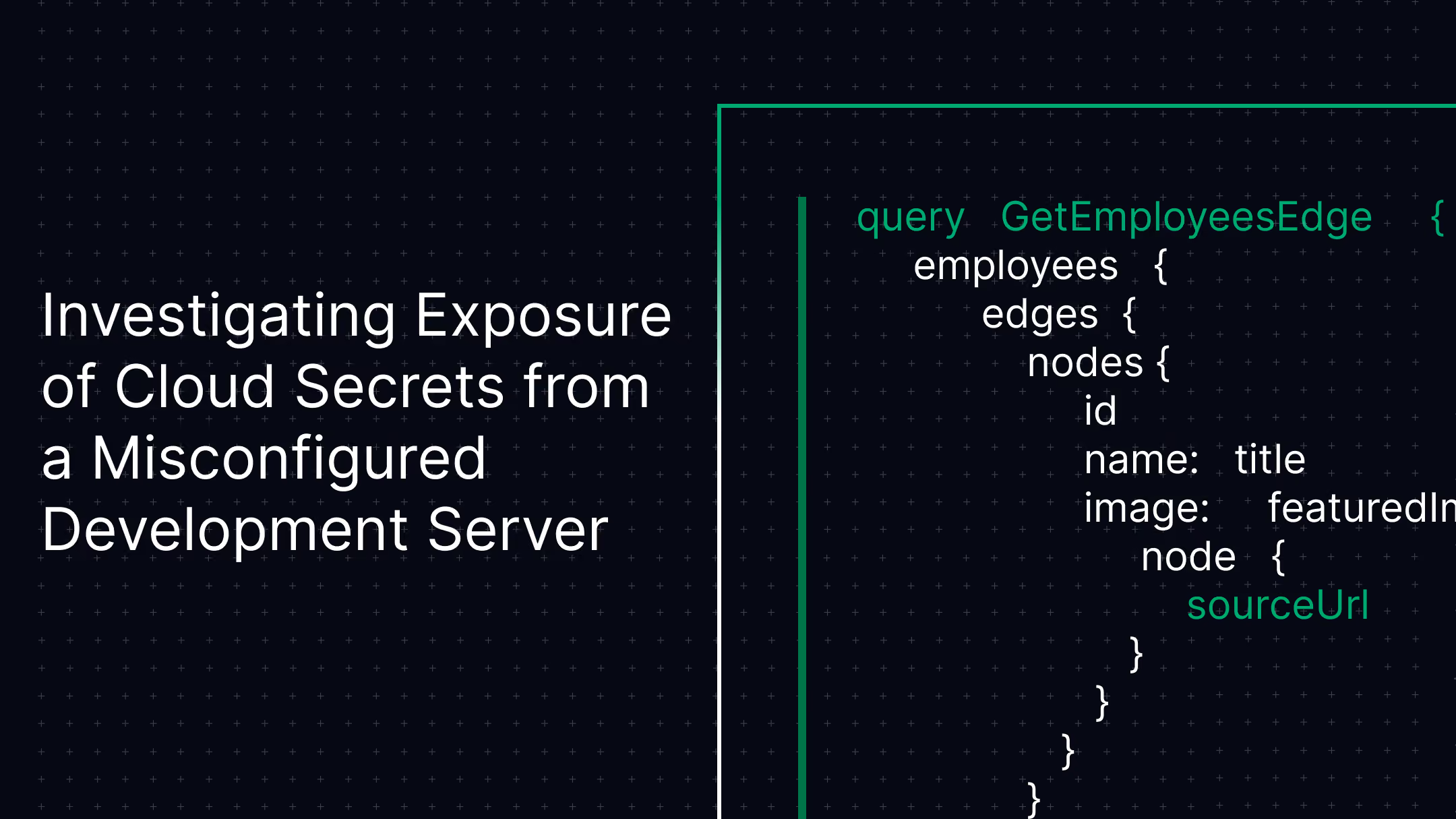
Exposed Cloud Secrets | AWS / Web Application | No Unauthorised Access
A misconfigured Symfony development server publicly exposed cloud credentials and application secrets, opening the door to a full AWS environment compromise.CyberQuell's forensic investigation confirmed no unauthorised access had occurred and rotated every exposed credential before it could be abused. Production systems untouched.
Incident type: Cloud secret exposure | Environment: AWS / Symfony | Credentials rotated: Before exploitation | Systems compromised: None

Case Study
Suspicious M365 Logins | Microsoft 365 / Azure AD | No Compromise Confirmed
Microsoft 365 security alerts flagged logins from unusual locations, pointing to a possible account takeover across the tenant.CyberQuell traced the anomalies to legitimate network routing behaviour and confirmed no compromise, sparing the organisation disruptive account resets while tightening identity monitoring.
Incident type: Suspicious authentication | Environment: Microsoft 365 / Azure AD | Root cause: Network routing | Systems compromised: None

Case Study
HR Document Exposure | Microsoft 365 / SharePoint | No Breach Confirmed
Confidential HR and compensation documents began surfacing in Microsoft 365 search results, triggering fears of a serious data breach.CyberQuell traced the exposure to permission inheritance and migration errors rather than an external attack, then restricted access and hardened Microsoft 365 governance.
Incident type: Internal data exposure | Environment: SharePoint / OneDrive | Root cause: Permission inheritance | External breach: None
.avif)
Case Study
White-Label SOC Partnership | Managed Service Provider | $12,400 MRR in 23 Days
A regional MSP needed to offer security monitoring to more than 40 SMB clients but had no SOC, no spare capital, and no security staff to build one.CyberQuell launched a fully white-labelled SOC in 23 days with zero capital outlay, generating $12,400 in monthly recurring revenue at 60 percent margins under the MSP's own brand.
Engagement type: White-label SOC | Time to revenue: 23 days | Client portfolio: 40+ SMBs | Capital investment: Zero
Do Not Stop at Finding Security Gaps. Fix Them.
CyberQuell helps you assess your environment, understand your real risks, and remediate the issues that matter most. Get a clear view of your security posture and a practical roadmap to improve it.

Why Choose CyberQuell for Security Assessments and Remediation?
CyberQuell helps you move from security uncertainty to a clear, prioritised action plan.
Beyond Reports
We do not stop at findings. CyberQuell helps you understand the risk, plan remediation, and close the gaps that matter most.
Expert-Led Assessment
Our assessments combine automated tooling with expert review, manual validation, penetration testing, and business risk context.
Microsoft Security Expertise
We understand Microsoft 365, Defender, Sentinel, Intune, Entra ID, Azure security, and the common gaps found in Microsoft-first environments.
Compliance-Ready Output
Findings can be mapped to NIST CSF, CIS Controls, ISO 27001, HIPAA, PCI-DSS, GDPR, and other relevant frameworks.
Prioritised Remediation
Your team gets clear next steps ranked by severity, exploitability, business impact, and effort.
Clear Communication
We provide reporting that technical teams can act on and leadership teams can understand.
Our Certifications
We pride ourselves on having a highly certified team, with each member continuously upgrading their skills to stay at the forefront of cybersecurity.



Hear from our clients
Do Not Stop at Finding Security Gaps. Fix Them.
CyberQuell helps you assess your environment, understand your real risks, and remediate the issues that matter most. Get a clear view of your security posture and a practical roadmap to improve it.
Frequently Asked Questions
Get answers to common questions Security Assessments and Remediation
A cybersecurity assessment usually includes vulnerability reviews, configuration checks, access control reviews, cloud or Microsoft 365 security checks, compliance mapping, and remediation guidance. CyberQuell gives you a clear report with prioritised findings and practical next steps. The goal is to help your team understand what needs attention and how to fix it.
A vulnerability assessment helps identify known weaknesses, misconfigurations, exposed services, and security gaps. Security remediation is the process of fixing those issues in a practical and prioritised way. CyberQuell supports both by helping you understand the findings, decide what matters most, and plan the right fixes.
The timeline depends on the size of your environment, number of systems in scope, cloud setup, compliance requirements, and the depth of review needed. Smaller assessments may be completed quickly, while broader cloud or Microsoft 365 reviews can take longer. CyberQuell confirms the expected timeline after the initial scope review.
Yes. CyberQuell provides remediation guidance and can support your team as you fix the issues. We help prioritise what needs immediate attention, what can be scheduled later, and what changes may reduce the most risk. Where needed, we can also validate key fixes after remediation.
Yes. CyberQuell can map findings to frameworks such as NIST CSF, CIS Controls, ISO 27001, HIPAA, PCI-DSS, and GDPR. This helps your team understand which gaps may affect audit readiness, cyber insurance, or internal governance. The goal is to make findings useful for both technical remediation and compliance reporting.
Automated tools are useful, but they often produce noisy findings without enough business context. They may miss chained risks, misread severity, or leave your team unsure what to fix first. CyberQuell combines tooling with expert validation, manual review, and practical remediation planning. That makes the output easier to trust and act on.
Most organisations should complete a security assessment at least once a year. Regulated industries, cloud-first teams, and fast-growing businesses may need assessments more often, especially after major IT changes, mergers, cloud migrations, new application launches, or security incidents. Regular assessments help catch new risks before attackers do.
A good security assessment report should include an executive summary, technical findings, severity ratings, evidence, business impact, affected systems, and remediation steps. CyberQuell also provides prioritised recommendations and framework mapping where relevant. The report is designed to help technical teams fix issues and help leadership understand risk.