

NESA Compliance Services for UAE Businesses
CyberQuell helps UAE businesses prepare for NESA compliance with gap assessment, control mapping, remediation support, and audit-ready evidence. Our team maps Microsoft Sentinel and Defender XDR outputs to NESA IAS requirements, helping organisations in Dubai, Abu Dhabi, and across the UAE move from compliance gaps to a stronger security posture.
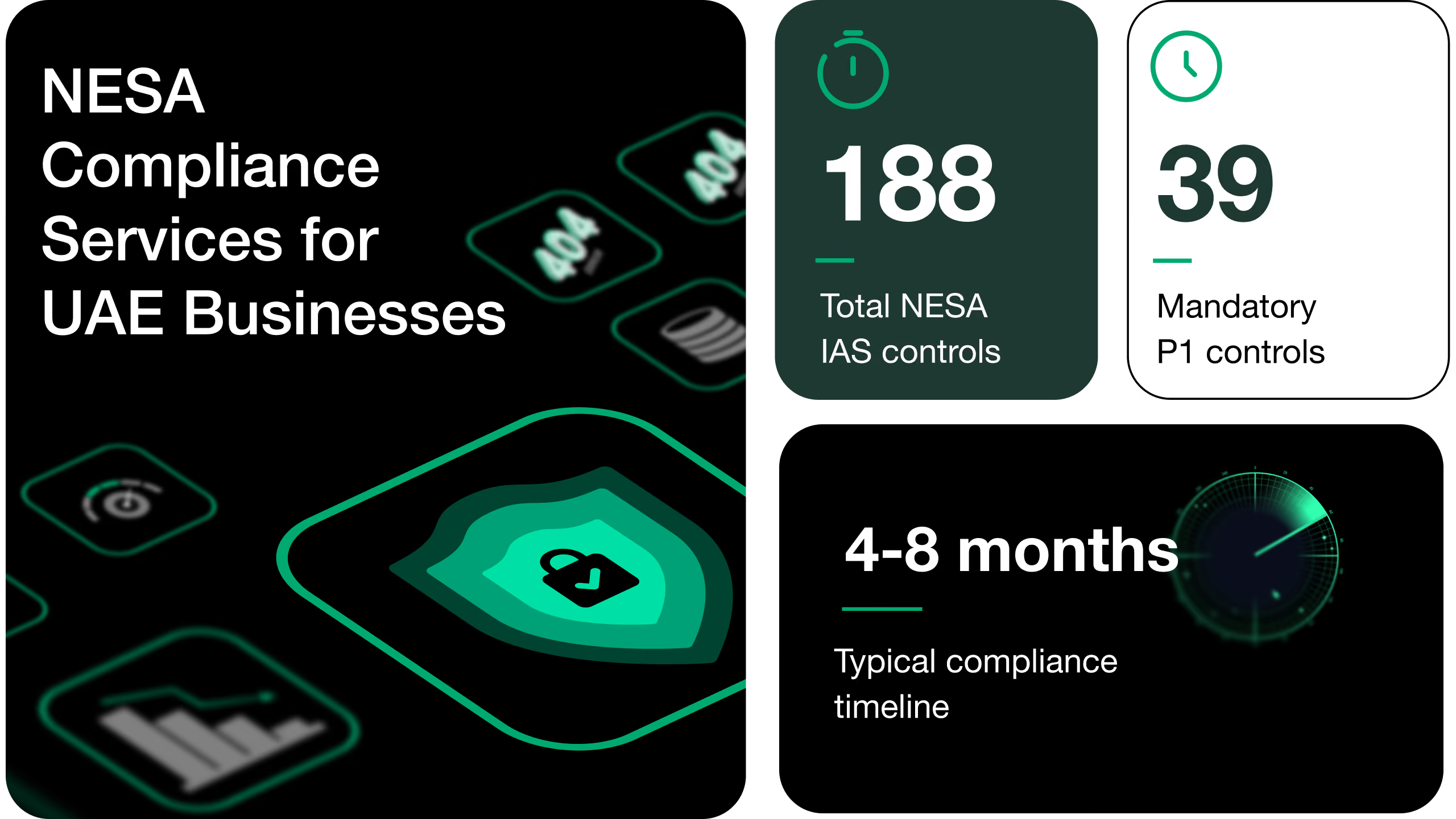
Total NESA IAS controls
Mandatory P1 controls
Typical compliance timeline
Monthly reporting included
What Is NESA Compliance in the UAE?
NESA compliance refers to meeting the UAE’s Information Assurance Standards, commonly called IAS. These standards define cybersecurity controls for government entities, critical infrastructure operators, regulated sectors, and their suppliers.
NESA is now part of the Signals Intelligence Agency, but the term “NESA compliance” is still widely used across UAE audits, tenders, and cybersecurity conversations.
The main goal is simple: prove that your organisation has the right security controls, monitoring, documentation, and response processes in place.
Who Needs NESA Compliance in the UAE?
NESA compliance mainly applies to UAE organisations that operate critical systems, work with government entities, or support regulated industries.
You may need to comply if you fall into one of these groups:

Critical infrastructure operators
Government entities, telecom providers, energy companies, financial institutions, healthcare providers, transport networks, and other organisations that operate critical national systems.

Supporting organisations
Technology vendors, IT service providers, cloud partners, managed service providers, software suppliers, and professional services firms that work with critical infrastructure operators.

Government suppliers
If your business wants to bid for UAE government contracts, NESA compliance may be required during procurement.
NESA IAS Controls: P1 to P4 Explained
The NESA IAS framework includes 188 cybersecurity controls, grouped by priority. CyberQuell starts with the highest-risk controls first, especially the mandatory P1 controls that auditors review closely.
| Priority | Number of controls | What it means |
|---|---|---|
| P1 | 39 | Mandatory controls that must be implemented first |
| P2 | 49 | Required unless a documented exception applies |
| P3 | 57 | Recommended controls for stronger maturity |
| P1 | 43 | Optional best-practice controls |
CyberQuell’s NESA gap assessment identifies which controls apply to your organisation, which ones are missing, and what evidence is needed for audit readiness.

CyberQuell’s NESA Compliance Process
NESA compliance requires more than a one-time audit. CyberQuell helps you assess gaps, fix priority controls, prepare evidence, and stay audit-ready through a structured process.
Step 1: Gap Assessment
We review your current security posture against NESA IAS controls, with priority given to mandatory P1 controls.
Step 2: Risk Assessment
We document key risks, affected assets, treatment plans, and ownership so your risk register is ready for audit review.
Step 3: Control Remediation
We help close security gaps across access control, logging, monitoring, vulnerability management, incident response, and related IAS requirements.
Step 4: Microsoft Sentinel Setup
We configure Microsoft Sentinel and Defender XDR to support NESA-aligned monitoring, alert review, and evidence collection.
Step 5: Documentation and Evidence
We prepare the policies, procedures, logs, reports, and evidence packs needed for internal review and external assessment.
Step 6: Audit Readiness Support
We help your team prepare for the formal assessment with pre-audit checks, remediation follow-up, and assessor-ready documentation.

How Much Does NESA Compliance Cost in the UAE?
NESA compliance costs depend on your organisation size, current security maturity, number of systems in scope, and how much remediation is needed before audit.
| Organisation type | Typical cost range | What affects cost |
|---|---|---|
| Small organisations | AED 20,000 to AED 80,000 | Number of systems, existing controls, documentation gaps |
| Mid-sized organisations | AED 80,000 to AED 200,000 | Multi-location scope, control remediation, audit preparation |
| Large or complex environments | AED 200,000+ | Multiple entities, regulated operations, full IAS implementation |
Are You Ready for a NESA Audit?
Before a NESA audit, you need more than security tools. You need proof that your controls are working, regularly reviewed, and properly documented.
CyberQuell reviews the key areas auditors commonly check, so you can identify gaps before the assessor does.

Security Policies
We check whether your policies are documented, approved, current, and aligned with NESA IAS expectations.

Risk Register
We review whether key risks are identified, assigned to owners, tracked, and supported by treatment plans.

Asset Inventory
We confirm whether your systems, users, data, and critical assets are documented and properly classified.
Access Control
We review MFA, admin accounts, privileged access, and whether access reviews are happening regularly.

Logging and Monitoring
We check whether key system logs are collected into a SIEM or equivalent monitoring platform.

Alert Review Evidence
We confirm whether security alerts are reviewed, investigated, and documented with clear analyst notes.

Vulnerability Management
We review scan records, patching activity, remediation tracking, and exception documentation.

Incident Response
We check whether you have a response plan, incident records, escalation paths, and post-incident review evidence.

Supplier Security
We review third-party access, vendor security clauses, and supplier risk documentation.
Audit Evidence
We help organise reports, screenshots, logs, policies, and other evidence needed for assessor review.
Start Your NESA Compliance Programme Today
Your organisation deserves more than a compliance checklist. CyberQuell delivers NESA compliance built on Microsoft Sentinel, with UAE data residency and monthly audit-ready reporting included.

Hear from our clients
Case Studies
See how these played out

Case Study
Emergency M365 Defederation | Legal Firm / 200 Mailboxes | Zero Email Downtime
A 200-mailbox law firm was locked inside GoDaddy's Microsoft 365 tenant, unable to reach the E3 security features their client-confidentiality obligations demanded.CyberQuell executed a full tenant defederation in four hours with zero email downtime, handing the firm complete administrative control and unlocking encryption, Conditional Access, and data loss prevention.
Engagement duration: 4 hours | Environment: 200 mailboxes | Email downtime: Zero | E3 security features unlocked: Yes
Case Study
BEC Payment Redirect | Events / Exhibitor | No Internal Breach
A fraudulent invoice using domain impersonation redirected a $5,562.50 exhibitor booth deposit to an attacker-controlled account.CyberQuell's investigation confirmed no internal breach had occurred, avoiding costly tenant-wide remediation and documenting the incident for financial and insurance claims.
Incident type: Business Email Compromise | Payment redirected: $5,562.50 | Attack method: Domain impersonation | Systems compromised: None
Case Study
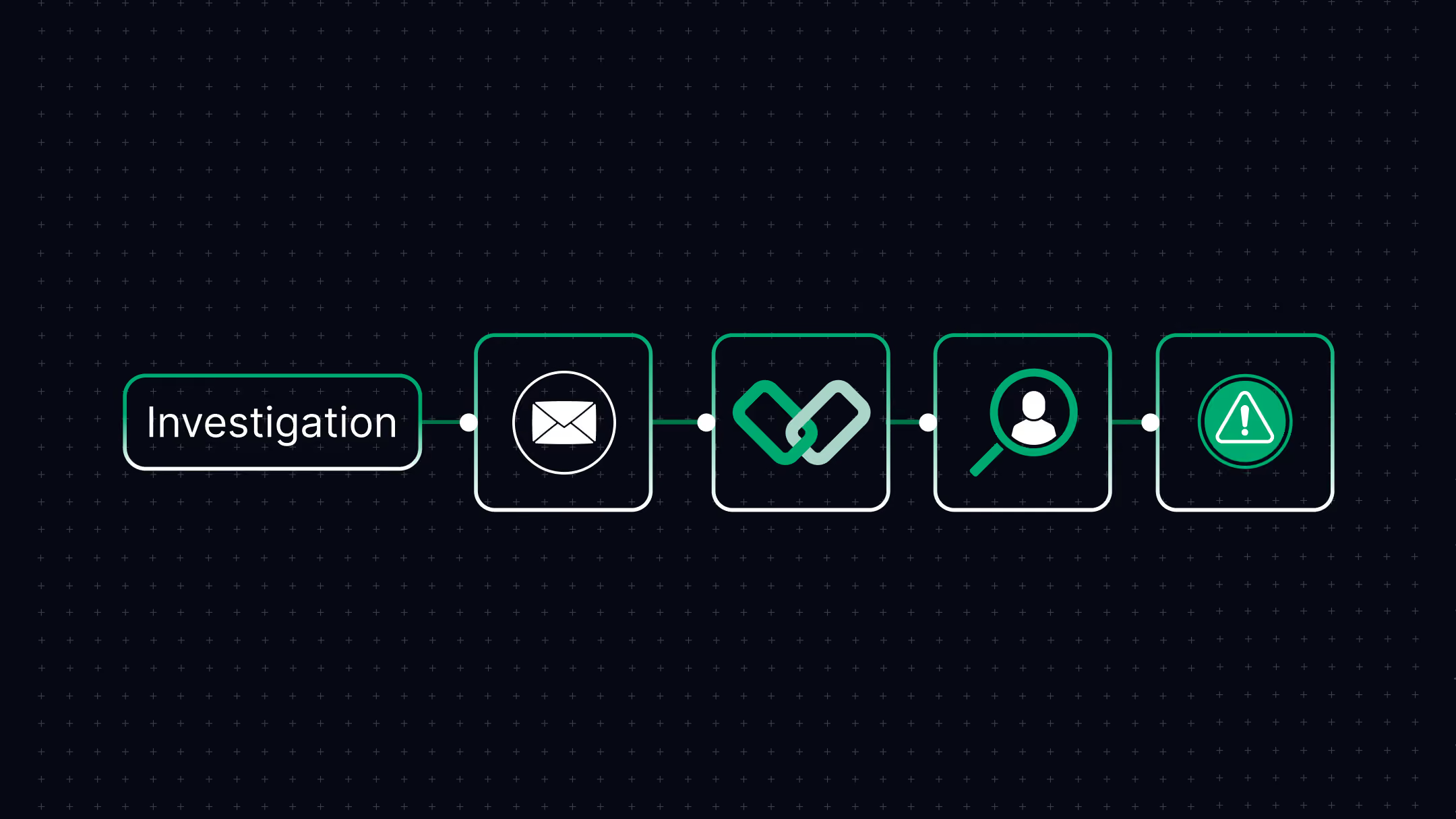
Multi-Phase BEC Campaign | Professional Services | $150,000+ Fraud Attempt Stopped
A sophisticated threat actor maintained persistent access to a bookkeeper's Microsoft 365 mailbox for four months, survived multiple remediation attempts, and orchestrated fraudulent payment requests to multiple clients totalling over $150,000.
CyberQuell's forensic investigation uncovered session token theft and malicious Outlook rules that had survived credential resets. Full threat eradication. Zero financial loss.
Attack duration: 4 months | Fraud attempted: $150,000+ | Financial loss: £0 | Previous remediation attempts failed: Yes

Case Study
Phishing Account Compromise | Microsoft 365 / Azure AD | Contained in Hours
A phishing attack compromised a single Microsoft 365 account, raising the threat of persistent mailbox access and data theft across the tenant.CyberQuell contained the account within hours, confirmed only a handful of emails were accessed, and verified no persistence mechanisms or data exfiltration remained.
Incident type: Phishing compromise | Environment: Microsoft 365 / Azure AD | Systems compromised: Single user account | Data exfiltration: None
Case Study
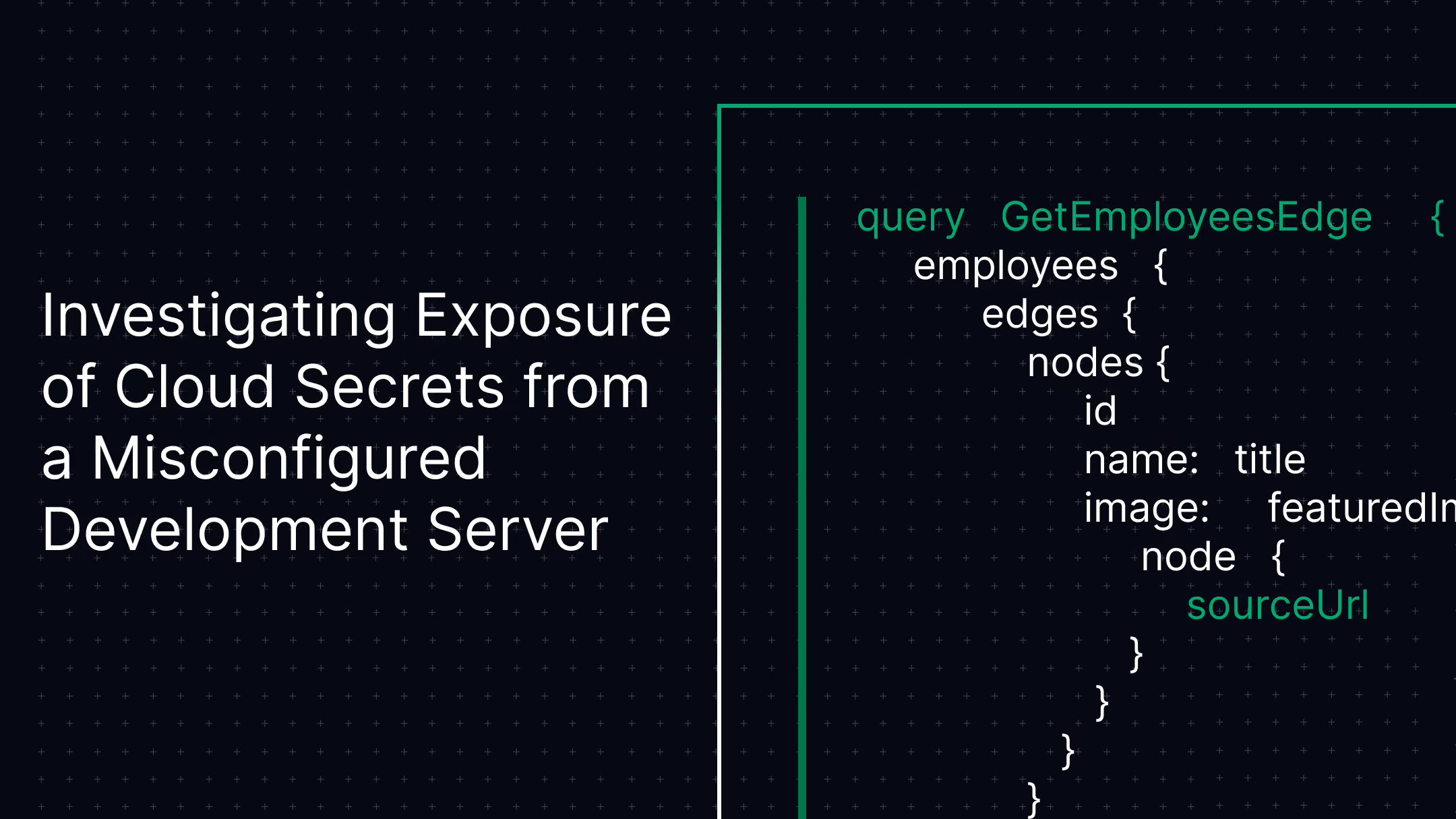
Exposed Cloud Secrets | AWS / Web Application | No Unauthorised Access
A misconfigured Symfony development server publicly exposed cloud credentials and application secrets, opening the door to a full AWS environment compromise.CyberQuell's forensic investigation confirmed no unauthorised access had occurred and rotated every exposed credential before it could be abused. Production systems untouched.
Incident type: Cloud secret exposure | Environment: AWS / Symfony | Credentials rotated: Before exploitation | Systems compromised: None

Case Study
Suspicious M365 Logins | Microsoft 365 / Azure AD | No Compromise Confirmed
Microsoft 365 security alerts flagged logins from unusual locations, pointing to a possible account takeover across the tenant.CyberQuell traced the anomalies to legitimate network routing behaviour and confirmed no compromise, sparing the organisation disruptive account resets while tightening identity monitoring.
Incident type: Suspicious authentication | Environment: Microsoft 365 / Azure AD | Root cause: Network routing | Systems compromised: None

Case Study
HR Document Exposure | Microsoft 365 / SharePoint | No Breach Confirmed
Confidential HR and compensation documents began surfacing in Microsoft 365 search results, triggering fears of a serious data breach.CyberQuell traced the exposure to permission inheritance and migration errors rather than an external attack, then restricted access and hardened Microsoft 365 governance.
Incident type: Internal data exposure | Environment: SharePoint / OneDrive | Root cause: Permission inheritance | External breach: None
.avif)
Case Study
White-Label SOC Partnership | Managed Service Provider | $12,400 MRR in 23 Days
A regional MSP needed to offer security monitoring to more than 40 SMB clients but had no SOC, no spare capital, and no security staff to build one.CyberQuell launched a fully white-labelled SOC in 23 days with zero capital outlay, generating $12,400 in monthly recurring revenue at 60 percent margins under the MSP's own brand.
Engagement type: White-label SOC | Time to revenue: 23 days | Client portfolio: 40+ SMBs | Capital investment: Zero
Live in 72 Hours: How CyberQuell Onboards a UAE Business
From your first call to live monitoring in 72 hours. Here is exactly how it works.
Discovery Call (45–60 minutes)
We scope your environment, identify your UAE regulatory obligations (NESA, FSRA, ADHICS), map your existing Microsoft stack, and confirm your priority risk areas. Clear plan. No jargon. Defined next steps before the call ends.
Environment Configuration
Microsoft Sentinel and Defender XDR are connected to your environment. NESA-aligned detection rules are deployed. Existing tools are integrated. Nothing gets ripped out or replaced. Your team keeps working without disruption.
Go Live
Within 72 hours of your discovery call, monitoring is active. Your analysts are briefed on your environment. Escalation contacts are confirmed. Your compliance dashboard is live. You receive written confirmation of exactly what is being monitored and how.
Ongoing Coverage
24/7 monitoring from day one. Real-time escalation on confirmed threats. Monthly compliance reports mapped to your UAE regulatory requirements. Quarterly threat landscape briefings tailored to UAE-specific developments.
Why UAE Businesses Choose CyberQuell for NESA Compliance

Microsoft-native - the only MSSP that maps Sentinel to NESA controls
NESA Domain T4 P1 requires a SIEM. CyberQuell runs Microsoft Sentinel, configured and managed natively. Every Sentinel output generates audit-ready evidence mapped to specific IAS control IDs. Evidence generation is built into the platform, not assembled manually the week before your audit.
UAE data residency via Azure UAE North and UAE Central
Your security logs, compliance evidence, and audit data never leave the UAE. Microsoft's UAE-region data centres hold DESC CSP certification, directly relevant to Dubai government entities and their suppliers. Your data sovereignty obligations are met by default, not as an afterthought.
Compliance integrated into managed security - not sold separately
Most NESA compliance providers deliver an audit engagement and walk away. CyberQuell's managed security delivery includes ongoing IAS control monitoring and monthly compliance reporting as standard. Your evidence set builds continuously, and your annual re-assessment becomes a confirmation, not a scramble.
UAE regulatory expertise across frameworks
NESA, FSRA, ADHICS, UAE PDPL, Dubai ISR — CyberQuell understands the full UAE regulatory landscape. For organisations with overlapping obligations across frameworks, we scope a unified compliance programme. No parallel engagements. No duplicated effort.
Our Certifications
We pride ourselves on having a highly certified team, with each member continuously upgrading their skills to stay at the forefront of cybersecurity.
Start Your NESA Compliance Programme Today
Your organisation deserves more than a compliance checklist. CyberQuell delivers NESA compliance built on Microsoft Sentinel, with UAE data residency and monthly audit-ready reporting included.
Frequently Asked Questions NESA Compliance Services
Common questions about NESA requirements, IAS controls, audit readiness, and CyberQuell’s compliance support for UAE businesses.
NESA compliance refers to meeting the Information Assurance Standards (IAS) set by the UAE's National Electronic Security Authority, now operating as the Signals Intelligence Agency (SIA). It applies to Critical Information Infrastructure operators across government, telecoms, energy, financial services, healthcare, and transport, as well as their supply chain partners. Organisations supplying technology or services to any Tier 1 entity are subject to IAS requirements.
The 188 NESA IAS controls are security requirements organised across 12 domains: 6 management domains covering governance, risk, and people security, and 6 technical domains covering access control, logging, network monitoring, incident management, and more. Controls are further prioritised into P1 (39 mandatory controls), P2 (49 conditional), P3 (57 recommended), and P4 (43 optional). All 188 are assessed at audit, with P1 controls examined first.
P1 controls are mandatory for all in-scope organisations and address the 80% of UAE cyber threats most commonly exploited. P2 controls are also mandatory unless a formally documented exception applies. P3 controls are recommended and expected at higher maturity levels. P4 controls are optional best practice. Auditors prioritise P1 findings, and non-compliance with a P1 control typically prevents certification.
Most organisations achieve NESA compliance in 4–8 months from initial gap assessment to certification. Organisations with existing ISO 27001 certification can reduce this to 2–4 months, as the ISMS framework satisfies the majority of management domain requirements. The timeline depends on the size of your environment, the depth of your starting gap, and the speed of internal remediation approvals.
Costs typically range from AED 20,000–80,000 for smaller organisations and AED 80,000–200,000 for mid-size environments. Large or complex environments with multiple regulated entities can exceed AED 200,000. Organisations with ISO 27001 in place generally reduce costs by 30–40%. Annual re-assessment costs are lower than the initial programme once the evidence infrastructure is in place. Book a free scoping call for a figure based on your organisation.
NESA was renamed the Signals Intelligence Agency (SIA) in 2024. The rebrand was an organisational change only. The Information Assurance Standards, the 188 IAS controls, audit requirements, and compliance timelines are all unchanged. "NESA compliance" remains the standard term used by organisations, auditors, and regulators. Your existing compliance programme does not need to change because of the rebrand.
ISO 27001 satisfies a significant portion of the NESA management domain requirements (M1 through M6), reducing both the time and cost of achieving NESA compliance. However, ISO 27001 does not cover all NESA technical domain requirements, particularly the P1 controls in T1, T3, T4, T5, and T6. ISO 27001-certified organisations still require NESA-specific gap assessment and technical remediation before certification.
NESA Domain T4 P1 mandates a SIEM or equivalent with documented evidence of alert review. This means log collection alone does not satisfy the control — you need evidence that alerts are being reviewed and actioned by an analyst. Microsoft Sentinel satisfies this requirement through its Analytics Rules engine, which generates alert records, analyst annotations, and incident logs that auditors can review directly.
Yes. Microsoft Sentinel is natively suited to NESA compliance. Sentinel's Log Analytics Workspace satisfies T3.6 centralised logging requirements. Its Analytics Rules engine satisfies T4 P1 alert review evidence requirements. Sentinel Incidents satisfy T6 incident management logging. Entra ID integration satisfies T1 privileged access monitoring. CyberQuell is the only UAE MSSP that has mapped Microsoft Sentinel capabilities directly to NESA IAS control IDs, with audit evidence outputs confirmed for each.
NESA non-compliance can result in regulatory fines reported to exceed AED 5 million for serious violations. Beyond financial penalties, non-compliant organisations are disqualified from UAE government procurement, which can represent a significant loss of contract eligibility for technology and professional services firms. Sector regulators, including the FSRA and CBUAE, may also take action where NESA non-compliance intersects with their own regulatory frameworks.