
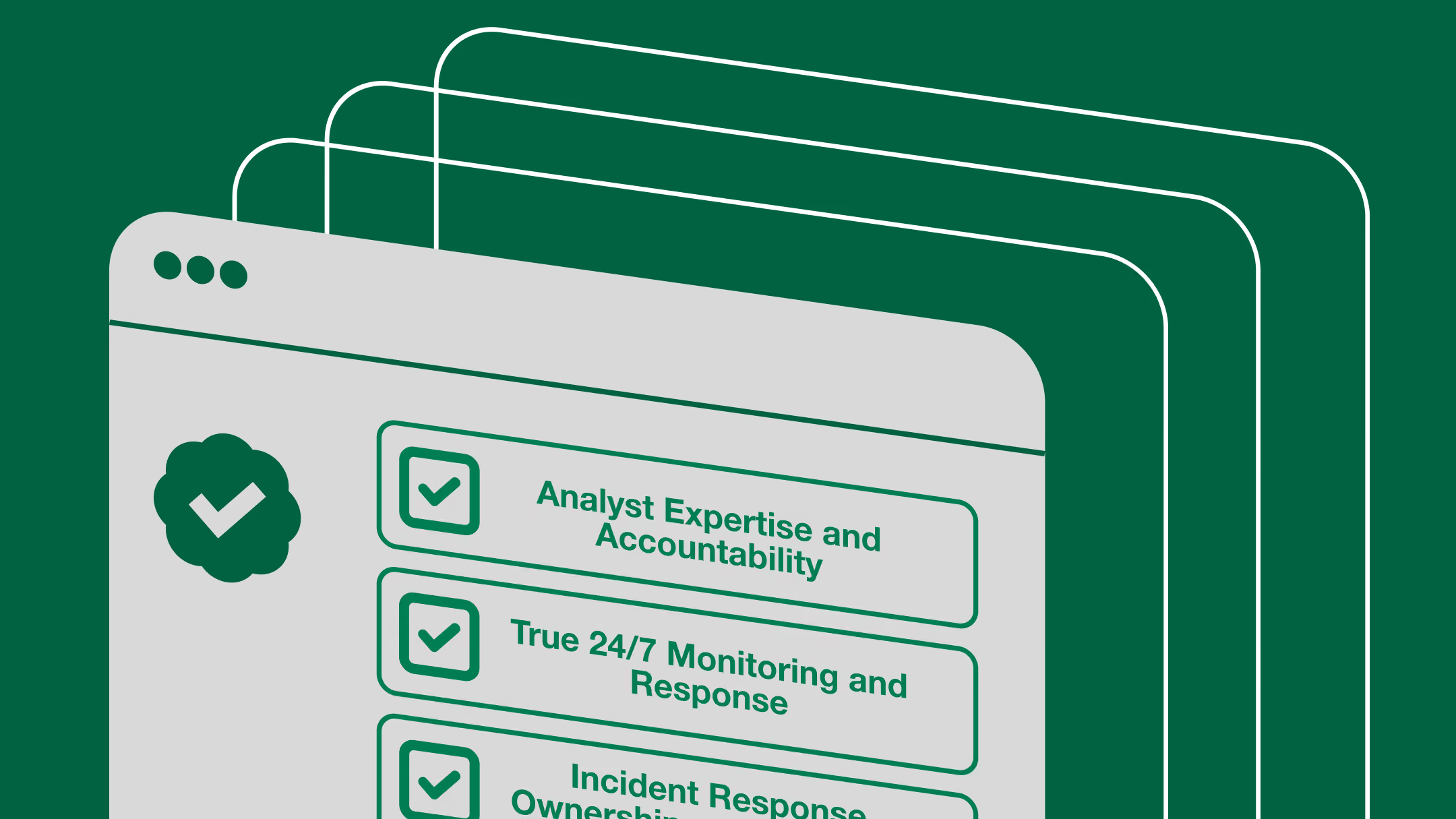
Most organisations evaluate SOC providers based on tools. SIEM platforms, EDR logos, and long integration lists often dominate vendor conversations. The problem is that these tools are now standard. Almost every SOC offers them, which means they no longer indicate real security effectiveness.
When SOC engagements fail, the root cause is rarely missing technology. It is gaps in analyst expertise, unclear incident ownership, slow response after hours, or weak detection and escalation processes. These issues only surface during real incidents, when it is already too late to fix them.
This guide helps security, IT, and risk leaders evaluate SOC providers based on outcomes. Instead of marketing claims, it focuses on what actually reduces risk. Analyst capability, true 24/7 response, detection quality, accountability, and measurable performance.
What “Beyond Tool Coverage” Means When Evaluating SOC Providers
Evaluating a SOC beyond tool coverage means looking past the technology stack and assessing how security outcomes are actually delivered. Tools generate data, but they do not investigate threats, make decisions, or stop attacks. A SOC’s effectiveness is determined by how that data is used in real time.
Tools alone do not equal protection. SIEM, EDR, and XDR platforms only provide visibility. Without skilled analysts, clear ownership, and the ability to respond at any hour, alerts remain noise and incidents escalate unchecked.
What actually drives SOC effectiveness comes down to a small set of operational factors. Human expertise determines whether alerts are understood and prioritised correctly. Continuous coverage ensures incidents are detected and acted on outside business hours. Clear incident ownership defines who is responsible for containment and remediation. Measurable response outcomes, such as detection and response times, show whether the SOC is improving security or simply monitoring it.
The Real Risks Organisations Are Trying to Avoid
When organisations evaluate SOC providers, the primary concern is not feature coverage. It is the risk of failure when a real incident occurs. Most security leaders are trying to avoid situations where threats are technically detected but operationally ignored.
One of the most common risks is incidents being missed or delayed after hours. Many SOCs claim 24/7 monitoring but rely on limited response outside business hours. This creates critical gaps during nights, weekends, and holidays when attackers are most active.
Alert fatigue is another major concern. SOCs that rely heavily on automated rules often generate high volumes of alerts without effective triage or containment. Over time, important signals are lost in the noise and response slows.
Unclear incident response processes introduce further risk. When ownership and escalation paths are not defined, containment is delayed while teams determine who is responsible. This lack of clarity also impacts compliance. If responsibilities are not clearly documented, organisations may fail audits or struggle to produce evidence during investigations.
Finally, decision-makers want to avoid long-term vendor lock-in. SOC providers that tightly couple services to proprietary tooling or rigid contracts make it difficult to adapt as security needs change, increasing both operational and financial risk.
The 8 Evaluation Criteria That Predict SOC Effectiveness
When evaluating SOC providers, these eight criteria consistently determine whether a SOC delivers real protection or simply manages tools. They focus on outcomes, not claims, and help separate mature SOCs from alert-only services.
1. Analyst Expertise and Accountability
The quality of a SOC depends heavily on the analysts who investigate and respond to incidents. It is important to understand who is reviewing alerts, what experience they have, and whether they are empowered to take action.
Strong SOCs employ experienced analysts who can validate threats, prioritise risk, and escalate incidents without delay. They maintain continuity across shifts so incidents are not handed off repeatedly without context.
Red flag: SOCs that rely primarily on junior analysts following scripted playbooks, with limited authority to respond or escalate.
2. True 24/7 Monitoring and Response
Many providers offer 24/7 monitoring, but monitoring alone does not stop attacks. The key distinction is whether the SOC actively responds to incidents at all hours or simply generates alerts outside business hours.
You should validate how incidents are handled during nights, weekends, and holidays. Ask who responds, how quickly, and what actions they can take without customer approval.
Red flag: Providers that monitor continuously but defer investigation or response until standard business hours.
3. Incident Response Ownership and Escalation
Clear ownership is critical during security incidents. A SOC should define exactly who is responsible for containment, remediation guidance, and escalation at each stage of an incident.
Effective SOCs document escalation paths, response timelines, and decision authority in advance. This reduces delays and confusion during high-pressure situations.
Red flag: Shared responsibility models that lack clear ownership or require extensive back-and-forth before action is taken.
4. Detection Engineering and Threat Hunting
Detection quality matters more than detection quantity. SOCs should build and maintain custom detections tailored to your environment rather than relying solely on default rules.
Mature providers continuously tune detections and perform regular threat hunting to identify attacker behaviour that automated tools miss. Detection capability should improve over time, not remain static.
Red flag: SOCs that deploy detections only during onboarding and rarely update or review them.
5. SOC Performance Metrics That Matter
Metrics provide insight into whether a SOC is delivering value. Outcome-based metrics such as mean time to detect, mean time to respond, and false positive rates are far more meaningful than alert counts.
Providers should be willing to share performance data and explain how metrics are tracked and improved. Transparency here indicates operational maturity.
Red flag: Providers that avoid sharing metrics or rely on vanity statistics that do not reflect real response effectiveness.
6. Coverage Depth and Visibility Gaps
Effective SOCs provide visibility across identity, cloud platforms, email, endpoints, and SaaS applications. Simply listing integrations is not enough. Providers should demonstrate how coverage is validated and where gaps may exist.
Understanding how blind spots are identified and addressed helps prevent attackers from exploiting unmonitored areas of the environment.
Red flag: SOCs that claim broad integration coverage but cannot explain how visibility is verified or maintained.
7. Reporting, Transparency, and Evidence
Clear communication and reporting are essential for both incident response and governance. SOC reports should include accurate timelines, actions taken, and outcomes, not just alert summaries.
Strong providers deliver both technical reports for security teams and executive-level summaries for leadership and audits. Evidence should be consistent and defensible.
Red flag: Vague, inconsistent, or delayed reporting that lacks actionable detail or audit-ready documentation.
8. Commercial Model, Flexibility, and Exit Risk
Beyond technical capability, the commercial structure of a SOC relationship matters. Contracts should allow for scaling, adaptation, and reasonable exit options as security needs evolve.
Vendor lock-in increases long-term risk, especially when services are tightly bound to proprietary tools or restrictive agreements.
If you are evaluating on behalf of clients rather than for your own organisation, the commercial model matters twice. You need a rate you can mark up and contract terms that do not trap your clients if you switch providers later. MSPs in that position should be reading white-label SOC pricing rather than standard managed SOC quotes. The two are built on different assumptions about who owns the client relationship.
Red flag: Long-term contracts with limited flexibility, unclear exit terms, or heavy dependence on proprietary platforms.
SOC Provider Red Flags to Watch For During Evaluation
Certain warning signs consistently indicate higher operational and security risk. If you encounter multiple red flags during evaluation, it is often a sign that the SOC will struggle during real incidents.
A common issue is the use of “24/7” language without clear response commitments. If a provider cannot define response SLAs, escalation timelines, or after-hours actions, coverage is likely limited to alerting rather than active response.
Another red flag is the absence of documented escalation paths. SOCs should clearly explain who responds at each severity level and when incidents are escalated. Vague or undocumented processes often lead to delays and confusion during incidents.
Providers that refuse to share performance metrics should also be treated cautiously. Mature SOCs track and report metrics such as detection and response times. A lack of transparency often signals weak operational maturity.
Unclear incident ownership introduces significant risk. If it is not explicit who is responsible for containment, communication, and remediation guidance, incidents can stall while responsibilities are debated.
Finally, be cautious of providers whose sales conversations focus heavily on tools rather than outcomes. Tool-centric messaging often masks gaps in analyst expertise, response capability, and accountability.
SOC Provider Evaluation Scorecard (How to Compare Vendors)
Purpose of a SOC evaluation scorecard
- Removes bias and marketing influence
- Enables objective, defensible vendor comparison
- Supports internal justification of decisions
Scoring approach
- Score vendors against consistent criteria
- Use a simple scale (e.g., 1–5)
- Base scores on evidence from discussions, documentation, and demos
Core evaluation categories
- Analyst expertise
- 24/7 response capability
- Incident ownership
- Detection maturity
- Performance metrics
- Coverage depth
- Reporting quality
- Commercial flexibility
Weighting criteria
- Not all categories carry equal importance
- Weighting should match risk profile and operating environment
Example weighting considerations
- Limited internal security teams: response ownership, after-hours coverage
- Highly targeted environments: detection engineering, threat hunting
- Budget-sensitive teams: commercial flexibility, exit options
Organisation-specific priorities
- SMBs: clear ownership, fast response, low operational burden
- Mid-market: balance response, integration, and reporting
- Regulated industries: evidence quality, audit support, escalation processes
Scorecard output
- Simple table with criteria, weights, and provider scores
- Enables alignment across security, IT, risk, and procurement teams
Questions You Should Ask SOC Providers
These questions are designed to move conversations beyond slide decks and tool demonstrations. They help clarify responsibility, response capability, and operational maturity before you commit to a provider.
Who responds to incidents after hours, and within what timeframe?
Ask for specific response times, escalation steps, and the level of authority analysts have outside business hours. Vague answers often indicate limited response capability.
Which incidents do you fully own, and which do you only advise on?
Clarify who is responsible for containment, remediation guidance, and communication at each severity level. Ownership should be documented, not implied.
How are detections maintained and improved over time?
Look for evidence of continuous tuning, threat hunting, and adaptation to your environment. Providers should explain how detections evolve beyond initial onboarding.
What metrics define SOC success, and how are they reported?
Request concrete metrics such as detection time, response time, and false positive reduction. Ask how performance trends are tracked and shared.
Walk us through a real incident response scenario.
Ask the provider to describe a recent incident from detection through containment and resolution. This reveals how processes work under real pressure, not just in theory.
Short Real-World SOC Evaluation Scenarios
Real incidents show why evaluating SOC providers based solely on tools can leave organisations exposed. The examples below illustrate both what can go wrong and what an effective SOC response looks like.
Scenario 1: After-Hours Ransomware Interrupted but Not Fully Detected
In a documented ransomware attack on a manufacturing firm, adversaries breached a domain controller in the early hours of the morning and attempted to launch encryption activities. Because the SOC had both human and automated detection capabilities, alerts triggered and the SOC took action before the attack could progress further. By 3:23 a.m., only minutes after the initial activity, the SOC had blocked and locked out the attackers, preventing damage and further spread. This demonstrates how effective after-hours detection and response can dramatically reduce impact. Reference
Scenario 2: Visibility Gaps Lead to Ransomware Success
In other documented ransomware incidents, attackers exploited credentials or security blind spots to infiltrate systems. In these cases, organisations had tools in place, but gaps in visibility and response coordination allowed lateral movement, privilege escalation, and data exfiltration, causing operational disruption and significant losses. These examples highlight the danger of relying on tools without ensuring integrated coverage and clear response ownership. Reference
The numbers that actually matter: average incident response time, containment rate, and time to first revenue for an MSP deploying SOC services. In a documented white-label SOC partnership, CyberQuell achieved an average 8-minute response time and 100% containment rate across 127 incidents over six months. Read the full partnership case study.
Final Recommendations for Evaluating SOC Providers
When selecting a SOC provider, focus on what truly reduces risk instead of getting caught up in marketing claims or technology lists. Prioritise response capability and accountability over tool coverage. Ensure that the SOC can actively investigate and remediate incidents, even outside business hours.
Validate coverage and escalation paths thoroughly. Confirm that all critical systems are monitored, blind spots are addressed, and responsibilities are clearly defined. Ask for documented processes that demonstrate how incidents are escalated and resolved.
Use a structured scorecard to evaluate providers objectively. Score each SOC against key criteria such as analyst expertise, detection quality, coverage depth, reporting, and commercial flexibility. Weight the criteria based on your organisation’s risk profile. This approach removes bias, allows side-by-side comparison, and provides a defensible rationale for your final selection.
Selecting a SOC provider based solely on tools is no longer enough. True security depends on human expertise, continuous coverage, clear incident ownership, and measurable response outcomes. Organisations that prioritise these factors significantly reduce risk and improve incident response effectiveness.
Evaluating SOC providers using an outcome-based approach allows your team to move beyond marketing claims and focus on real operational capability. By assessing analyst skill, 24/7 coverage, detection quality, escalation processes, and reporting transparency, you ensure that your SOC delivers tangible protection for your environment.
At Cyberquell, we turn complexity into clarity by delivering SOC services that align precisely with your business, compliance obligations, and risk profile. Stop evaluating options and start securing outcomes. Request a Cyberquell quote today and take control of your security operations.
%20for%20Microsoft%20365%20(1).png)
.png)
.png)
