
Key Takeaways
- Real-time threat detection is essential to meet ADGM’s 24-hour incident reporting requirement and overall UAE compliance.
- DIFC, ADGM, and NCA frameworks demand continuous monitoring, active response, and provable security operations not just documented policies.
- Most UAE organisations struggle with in-house SOC due to limited 24/7 coverage, talent shortages, high costs, and slow implementation timelines.
- A managed SOC bridges the gap by delivering continuous monitoring, rapid incident response, and audit-ready reporting aligned with regulations.
- Compliance success depends on operational capability if you can’t detect, respond, and prove it in real time, you’re not compliant.
You cannot meet ADGM’s 24-hour incident notification requirement if you are not detecting incidents in real time. And if you’re not detecting incidents in real time, you’re not compliant, no matter how strong your policies look on paper.
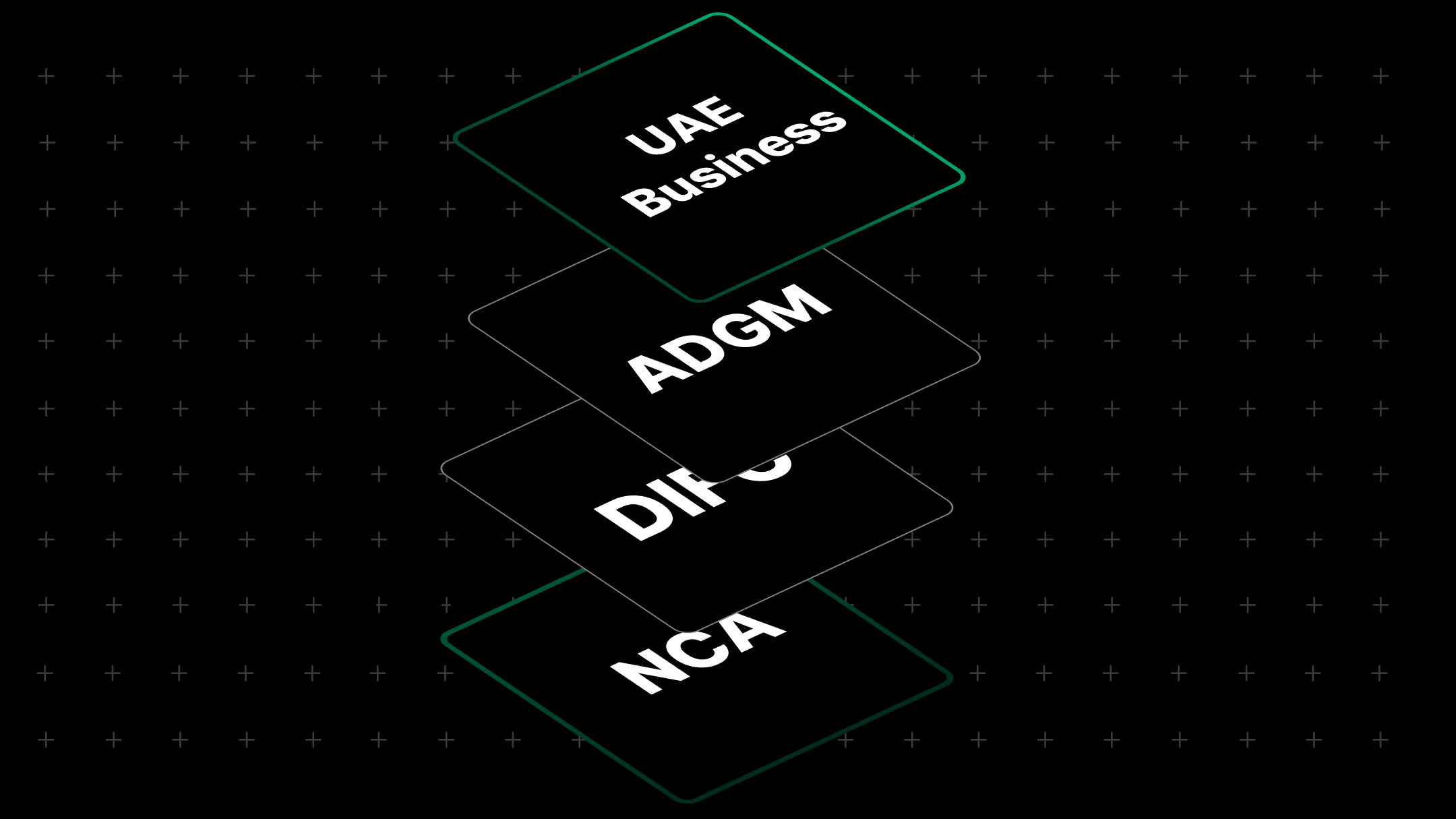
Across DIFC, ADGM, and NCA frameworks, the expectation is clear. Businesses must have continuous monitoring, threat detection, and a documented incident response capability. These are not theoretical requirements. They are operational. Yet most UAE-based organisations do not have the internal infrastructure, tooling, or 24/7 coverage needed to meet them consistently.
This is where many compliance efforts break down. Not because businesses do not understand the rules, but because they lack the real-time security operations layer required to enforce them.
Compliance in the UAE is no longer about having the right documentation. It is about proving you can detect, respond to, and report incidents as they happen.
A managed Security Operations Center (SOC) addresses this gap directly. It provides the continuous monitoring, detection, and response capabilities that regulators expect, without requiring you to build and manage a full in-house security team.
If you’re not yet clear on which UAE compliance framework applies to your business, start with our guide to DIFC, NCA, and ADGM requirements. In this article, we go a step further by mapping each specific compliance requirement to the exact SOC capability that enables it.
Why UAE Cybersecurity Compliance Now Requires 24/7 Monitoring
UAE cybersecurity compliance has shifted from policy-driven frameworks to enforcement-driven expectations. Regulators are no longer satisfied with documented controls alone. They expect organisations to demonstrate that security controls are actively operating at all times.
Across DIFC, ADGM, and the NCA framework, the common requirement is clear. Businesses must be able to monitor their environments continuously, detect threats as they occur, and respond within defined timeframes. This is not a periodic or manual process. It requires real-time visibility across systems, users, and data.
The ADGM 24-hour incident notification requirement makes this especially critical. To report an incident within 24 hours, you must first detect and validate it quickly. If detection is delayed by hours or days, the reporting window becomes impossible to meet. In practice, this means organisations need continuous monitoring and rapid alert triage in place at all times.
This is where many compliance strategies fall short. Logs may exist, and tools may be deployed, but without active monitoring and response, they do not meet regulatory expectations. Detection without immediacy does not support compliance.
So, does UAE cybersecurity compliance require 24/7 monitoring? In practical terms, yes. Without continuous monitoring, you cannot reliably detect incidents, respond in time, or meet regulatory reporting obligations.
Why Most UAE Businesses Cannot Meet These Requirements In-House
On paper, the requirements set by DIFC, ADGM, and NCA seem achievable. In reality, most organisations struggle to operationalise them internally.
The first challenge is coverage. Compliance frameworks expect continuous monitoring, which effectively means 24/7 visibility and response. Most internal IT or security teams operate during business hours, leaving nights, weekends, and holidays uncovered. Threats do not follow business hours, and neither do regulatory expectations.
The second issue is the shortage of skilled cybersecurity talent. Building an in-house SOC requires experienced analysts across multiple tiers, from alert triage to advanced incident response. These roles are difficult to hire for, especially in the UAE market where demand for security expertise continues to outpace supply.
Even when organisations invest in tools like SIEM platforms, another gap appears. A SIEM is not a solution on its own. It generates alerts, but those alerts still need to be monitored, analysed, and acted on. Without dedicated analysts and defined workflows, the tool becomes underutilised, and critical threats can be missed.
Cost is another major barrier. Establishing an in-house SOC requires significant investment in technology, hiring, training, and ongoing operations. For most SMEs and mid-sized organisations, this level of investment is not practical, especially when compliance timelines are tight.
Finally, there is the issue of time. Building a functional SOC from scratch can take months or even longer. With regulatory deadlines approaching, particularly around ADGM enforcement timelines, many businesses simply do not have the runway to build these capabilities internally.
Taken together, these challenges are structural, not temporary. Most UAE businesses are not failing compliance because of a lack of awareness, but because they lack the operational capacity to meet these requirements on their own.
The Exact Cybersecurity Requirements You Need to Meet (Simplified)
To meet DIFC, ADGM, and NCA expectations, you do not need to interpret every line of each framework. At a practical level, compliance comes down to a small set of operational capabilities that your organisation must have in place and be able to prove.
1. Continuous Monitoring
You need real-time visibility across your environment at all times. This includes endpoints, email, cloud systems, and user activity. Monitoring cannot be periodic or manual. It must be continuous and actively reviewed.
2. Threat Detection
It is not enough to collect logs. You must be able to detect suspicious behaviour and potential threats as they occur. This means identifying anomalies, correlating events across systems, and distinguishing real threats from noise.
3. Incident Response (Including 24-Hour Notification)
You must have a defined process to investigate, contain, and respond to security incidents. This includes escalation paths, response procedures, and documentation.
For ADGM-regulated firms, this requirement is stricter. From January 2026, material incidents must be reported within 24 hours of detection. This makes fast detection and response essential, not optional.
4. Log Management (SIEM)
All relevant security data must be centrally collected and retained. This includes logs from endpoints, identity systems, cloud platforms, and applications. The data must be searchable and usable for investigation and reporting.
5. Audit-Ready Reporting
You must be able to demonstrate compliance through evidence. This includes incident reports, monitoring records, and documented response actions. Regulators expect clear, structured outputs that show what happened and how it was handled.
6. Access Monitoring
You need visibility into how users access systems and data. This includes detecting unusual login behaviour, privilege misuse, or unauthorised access attempts. This is particularly important for protecting sensitive data and meeting data protection obligations.
These requirements are consistent across DIFC, ADGM, and NCA frameworks. While the language may differ, the expectation is the same. You must be able to monitor, detect, respond, and prove it.
Mapping UAE Compliance Requirements to Managed SOC Capabilities
At this point, the gap becomes clear. UAE regulations define what you need to achieve, but they do not tell you how to operationalise it.
This is where a managed SOC becomes critical. It translates each compliance requirement into a concrete, continuously operating capability.
Below is a direct mapping of what regulators expect and how a managed SOC delivers it in practice:
This mapping highlights a key reality. Compliance is not achieved through isolated tools or policies. It requires a coordinated set of capabilities that are continuously operating, monitored, and documented.
A managed SOC brings these capabilities together into a single operational layer. Instead of trying to build each component separately, you are implementing a system that is already aligned to what regulators expect.
What UAE Regulators Actually Expect During an Audit
Meeting compliance requirements is only part of the challenge. The real test comes during an audit, where regulators expect you to prove that your controls are working in practice.
This is where many organisations fall short. They may have tools in place, but they cannot demonstrate consistent operation, documented response, or historical evidence.
In an audit scenario, regulators typically look for the following:
Proof of Continuous Monitoring
It is not enough to say monitoring is in place. You need to show that systems are being actively monitored at all times. This includes evidence of alert generation, analyst review, and ongoing visibility across your environment.
Incident Timelines, Not Just Alerts
Auditors do not want raw alerts. They expect a clear timeline of what happened during an incident. This includes when the threat was detected, how it was investigated, what actions were taken, and how it was resolved.
Log Retention Evidence
You must demonstrate that logs are being collected, stored, and retained in line with regulatory expectations. This often means showing access to historical data over defined periods, typically 12 months or more.
Documented Incident Response
Regulators expect to see structured response processes. This includes playbooks, escalation paths, and records of how incidents were handled. Ad hoc or undocumented responses do not meet compliance standards.
Audit-Ready Reports
Finally, you need to present all of this information in a format that regulators can review easily. This includes incident reports, monitoring summaries, and compliance documentation that clearly demonstrate control effectiveness.
The key insight is simple. Compliance is proven through evidence, not claims. It is not about stating that controls exist, but about showing how they operate over time.
A managed SOC is designed to produce this evidence by default. Monitoring logs, incident timelines, response actions, and reporting outputs are continuously generated as part of daily operations. Instead of preparing for audits manually, you already have the documentation and proof required when regulators ask for it.
How a Managed SOC Delivers These Capabilities in Practice
Understanding the requirements is one thing. The real question is how these capabilities operate on a day-to-day basis.
A managed SOC brings together people, processes, and technology into a continuous workflow that runs in the background of your organisation. Each component plays a specific role in meeting compliance expectations.
24/7 Security Monitoring
A managed SOC provides continuous visibility across your entire environment. This includes endpoints, email systems, cloud platforms, and identity services.
All relevant activity is monitored in real time, ensuring that no critical events are missed due to gaps in coverage. This directly supports the requirement for continuous monitoring across DIFC, ADGM, and NCA frameworks.
Threat Detection and Alert Triage
Not every alert represents a real threat. One of the key functions of a SOC is to filter noise and prioritise what actually matters.
Events from multiple systems are analysed and correlated to identify suspicious behaviour. Analysts then triage alerts, separating false positives from genuine threats. This ensures that real incidents are identified quickly and acted upon without delay.
Incident Response and 24-Hour Notification
When a threat is confirmed, the SOC follows a structured response process. This includes investigation, containment, escalation, and documentation.
These workflows are designed to ensure that incidents are handled consistently and efficiently. For ADGM-regulated firms, this also enables timely notification within the required 24-hour window, as incidents are detected and validated early in their lifecycle.
SIEM and Log Correlation
A managed SOC centralises data from across your environment into a single system. Logs from endpoints, identity platforms, cloud services, and applications are collected and analysed together.
This allows for cross-system visibility, making it possible to detect patterns and behaviours that would not be visible in isolated tools. It also ensures that all relevant data is available for investigation and compliance reporting.
Compliance Reporting
All monitoring and response activities are documented as part of normal SOC operations. This includes incident reports, timelines, and summaries of actions taken.
These outputs are structured in a way that aligns with regulatory expectations. Instead of manually compiling evidence during an audit, organisations have access to clear, audit-ready reports that demonstrate how security controls are functioning in practice.
Together, these capabilities form a continuous operational layer that aligns directly with UAE compliance requirements. Instead of managing each requirement separately, a managed SOC delivers them as part of an integrated system.
What Gets Missed Without 24/7 SOC Monitoring
A useful way to understand the importance of continuous monitoring is to look at what happens when it is missing.
In a recent multi-phase business email compromise (BEC) campaign, attackers were able to maintain access to a corporate environment for over four months without being detected. This was not due to a lack of tools, but a lack of continuous monitoring and active analysis.
The attackers used OAuth token abuse to gain persistent access to user accounts. They then created malicious Outlook rules to intercept and redirect email communications. From the outside, everything appeared normal. There were no obvious signs of compromise unless activity was being actively monitored and correlated across identity and email systems.
Because there was no real-time visibility, these behaviours went unnoticed. No alerts were investigated, and no anomalies were escalated. The attack continued quietly in the background, increasing both operational and regulatory risk over time.
From a compliance perspective, this creates a critical failure point. Under ADGM requirements, material incidents must be reported within 24 hours of detection. In this scenario, detection did not happen for months. That means the reporting requirement could not be met, regardless of how well-defined the response process may have been on paper.
This example highlights a simple but important reality. Without continuous SOC monitoring, incidents are not detected when they occur. If incidents are not detected, they cannot be investigated, contained, or reported within regulatory timelines.
Without detection, there is no response. And without response, there is no compliance.
What a Managed SOC Deployment Looks Like in Practice
To understand how a managed SOC supports compliance, it helps to look at how it operates in a real environment.
In a recent white-label SOC deployment, a full monitoring and response capability was implemented across multiple client environments in just 23 days. This is a critical factor for organisations working against regulatory timelines, especially those needing to meet upcoming ADGM enforcement requirements.
Once live, the SOC provided continuous 24/7 coverage through dedicated L1, L2, and L3 analysts. This ensured that all alerts were actively monitored, investigated, and escalated without delay, regardless of time or day.
Within the first 30 days of operation, 18 security incidents were detected and contained. These were not theoretical alerts, but real threats that required investigation and response. Each incident was handled through structured workflows, producing documented timelines and actions that could be used for compliance reporting.
The average response time across incidents was 8 minutes. This level of responsiveness is directly aligned with regulatory expectations. Fast detection and rapid triage are what make it possible to meet requirements such as ADGM’s 24-hour incident notification window.
This example demonstrates how a managed SOC translates compliance requirements into operational outcomes. Continuous monitoring is active from day one, incidents are detected and handled in real time, and the organisation has the visibility and documentation needed to meet regulatory obligations.
Managed SOC vs In-House SOC for UAE Compliance
When it comes to meeting UAE cybersecurity compliance requirements, the decision often comes down to whether to build an in-house SOC or adopt a managed SOC. In practice, this is less about preference and more about feasibility.
Building an in-house SOC requires significant investment across hiring, tooling, and process development. Even then, achieving full operational maturity takes time, which many organisations do not have given regulatory deadlines.
There is also the hidden cost of non-compliance. Failing to meet requirements such as incident detection or 24-hour notification can lead to regulatory penalties, delayed approvals, or reputational damage. In parallel, the cost of a security breach, especially one that goes undetected for an extended period, can far exceed the investment required for proper monitoring and response.
A managed SOC reduces both risks. It provides immediate access to the capabilities regulators expect, without the delays and complexity of building them internally.
For most UAE businesses, the conclusion is straightforward. A managed SOC is the fastest and lowest-risk path to achieving and maintaining compliance.
What to Expect in the First 90 Days
One of the key advantages of a managed SOC is how quickly it moves you from limited visibility to compliance-ready operations. Instead of a long build phase, capabilities are delivered in structured stages, each aligned to regulatory expectations.
Days 1–30: Monitoring and Response Go Live
In the first month, continuous monitoring is established across your environment. Data sources such as endpoints, email, cloud platforms, and identity systems are integrated, and real-time visibility begins immediately.
At the same time, an initial threat baseline is created. This helps distinguish normal activity from suspicious behaviour. Incident response playbooks are also defined and tested, ensuring that any detected threats can be handled in a structured and repeatable way.
Compliance impact: You move from no monitoring to active detection and response, addressing core requirements for continuous monitoring and incident handling.
Days 30–60: Evidence and Reporting Take Shape
With monitoring fully operational, the focus shifts to generating compliance evidence. Security events are tracked, incidents are documented, and reporting begins to take form.
Log retention is aligned with regulatory expectations, ensuring that data is stored and accessible for audit purposes. Initial reports provide visibility into incidents, response actions, and overall security posture.
Compliance impact: You begin to build the documentation and evidence required to demonstrate that controls are functioning as expected.
Days 60–90: Audit Readiness and Gap Closure
By this stage, the SOC is operating as a mature, continuous function. A formal assessment is conducted to identify any remaining gaps against DIFC, ADGM, or NCA requirements.
Audit-ready documentation is consolidated, including incident reports, monitoring records, and response workflows. Regular reporting is established, supporting both internal stakeholders and regulatory expectations.
Compliance impact: You transition from operational capability to full audit readiness, with the ability to demonstrate compliance through structured evidence and reporting.
Within 90 days, a managed SOC moves you from limited visibility to a position where monitoring, detection, response, and reporting are all functioning as a cohesive system. This structured progression is what enables organisations to meet compliance requirements within realistic timelines.
UAE Compliance Checklist (SOC-Aligned)
To quickly assess where you stand, here is a simplified checklist of the core capabilities required to meet UAE cybersecurity compliance expectations:
- 24/7 monitoring is active across systems, users, and data
- Threat detection is operational and alerts are actively reviewed
- Incident response processes are defined, documented, and repeatable
- 24-hour incident notification capability is in place (especially for ADGM)
- SIEM and log management are implemented with centralized visibility
- Audit-ready reporting is available, including incident timelines and evidence
If any of these are missing or only partially implemented, there is a clear compliance gap.
A managed SOC brings all of these capabilities together into a single, continuously operating function. Instead of building each component separately, it delivers a complete, compliance-aligned security operations layer from day one.
Who Needs a Managed SOC for UAE Compliance
A managed SOC is most relevant for organisations that are required to demonstrate continuous monitoring, threat detection, and incident response as part of UAE regulatory expectations.
This includes:
- DIFC and ADGM regulated financial firms that must meet strict cybersecurity and incident reporting requirements
- Companies entering the UAE market that need to establish compliance readiness quickly to obtain approvals or operate in regulated environments
- SMEs without an internal SOC or dedicated security team, but still required to meet baseline cybersecurity standards
- Cloud-first organisations that operate across distributed environments and need unified visibility across identity, applications, and infrastructure
- Businesses preparing for audits or regulatory assessments that must produce evidence of monitoring, detection, and response capabilities
Across these groups, the common challenge is not awareness of compliance requirements, but the lack of operational capability to meet them consistently. A managed SOC is designed to close that gap by providing continuous security operations aligned with regulatory expectations.
If your organisation operates in DIFC, ADGM, or under the NCA cybersecurity framework, the next step is to move beyond documentation and focus on operational readiness. Compliance in the UAE is now driven by continuous monitoring, real-time detection, and the ability to respond to incidents within defined regulatory timelines.
CyberQuell helps organisations bridge this gap with a managed SOC designed specifically for UAE compliance requirements. This includes 24/7 monitoring, structured incident response, SIEM-based log management, and audit-ready reporting aligned with DIFC, ADGM, and NCA expectations.
The first step is to assess your current security posture and identify gaps in monitoring, detection, and response capabilities. From there, a managed SOC can be implemented quickly to establish continuous visibility across your environment and ensure incidents are detected and handled in real time.
With CyberQuell’s managed SOC, organisations can move rapidly from fragmented security tools to a fully operational security function that supports both compliance and resilience. This enables faster audit readiness, stronger incident handling, and alignment with UAE regulatory requirements from day one.
.png)
