

Key Takeaways
- A managed SOC gives you 24/7 monitoring, investigation and response from an external team, without hiring the four to five analysts it takes to cover 168 hours a week.
- Half the providers here do not publish pricing at all, including Microsoft Defender Experts for XDR, which is quote only.
- Response authority decides more than price, so confirm whether the provider isolates an endpoint or only sends you an alert at 3am.
- Companies already on Microsoft 365 E5 own most of the detection layer and should be buying operations, not a second tool stack.
- Score your own readiness before you score vendors, because no provider fixes missing asset inventory or unowned identity monitoring for you.
Every provider here promises 24/7 coverage and fast response, and few publish enough detail to check the claim against a rival. This guide scores eight managed SOC providers against five weighted criteria, with published pricing where it exists and a plain note where it does not. For companies between 50 and 500 employees, the deciding factor is response authority, not detection quality.
Who This Guide Is For
- Small business and SMB leaders with 50 to 500 employees weighing outsourced security operations against the cost of hiring a first analyst.
- IT leads preparing for SOC 2, HIPAA or ISO 27001 who need documented evidence of 24/7 monitoring, not just a tool that logs.
- Teams where one or two IT generalists carry security part-time alongside helpdesk, patching and everything else.
- Companies already running Microsoft Defender or a SIEM that want it operationalised rather than ripped out and replaced.
10 Managed SOC Providers Compared: Capability and Fit
The fastest way to shortlist a managed SOC provider is to check two things before price: what the service can do without asking your permission, and what you have to already be running for it to work at all. Those two columns eliminate more vendors than cost does. Every figure below comes from the provider's own documentation, checked in August 2026.
Provider documentation checked 21 August 2026.
What These Providers Actually Publish
One of these ten publishes a rate card. The rest route you to a form. A vendor that will not name a number until it knows your headcount is pricing you, not the service.
Vendor pricing pages and marketplace listings checked 21 August 2026. Marketplace rates are list prices; larger deployments are quoted privately.
MSSP, MDR, MXDR, SOCaaS and Co-Managed SOC: What the Terms Actually Mean
These five terms get used interchangeably in sales calls and they are not the same purchase. The difference is who acts when something fires at 3am. For a deeper split between the two most confused terms, see our comparison of MDR and SOC models.
How We Scored These Providers
The five criteria
- Response and containment (25%): whether the provider acts or escalates, and whether a response time is contractual.
- Cloud and identity coverage depth (25%): how far past the endpoint the service actually reaches.
- Pricing transparency (20%): whether you can find a rate without a sales call.
- Compliance evidence and reporting (15%): what you can hand an auditor.
- Onboarding speed and stack fit (15%): what you have to rip out to start.
The scores
*Scored on the absence of any published rate, not on a rate we judged poor value.
What these scores are built from
Vendor documentation, service descriptions, pricing pages and marketplace listings, checked 21 August 2026. No aggregator, reseller or review-site figures were used.
If your current setup fails on the criteria above, check out CyberQuell to see what a 15-minute response SLA on your own Microsoft licences would look like in your environment.
Top 10 Managed Security Service Providers in the USA for 2026
These are the MSSPs delivering the strongest mix of threat detection, response speed, cloud capability, and SOC maturity.
Each listing is concise but meaningful and based on publicly verifiable strengths, not filler.
1. CyberQuell – Modern MXDR + Cloud-First SOC
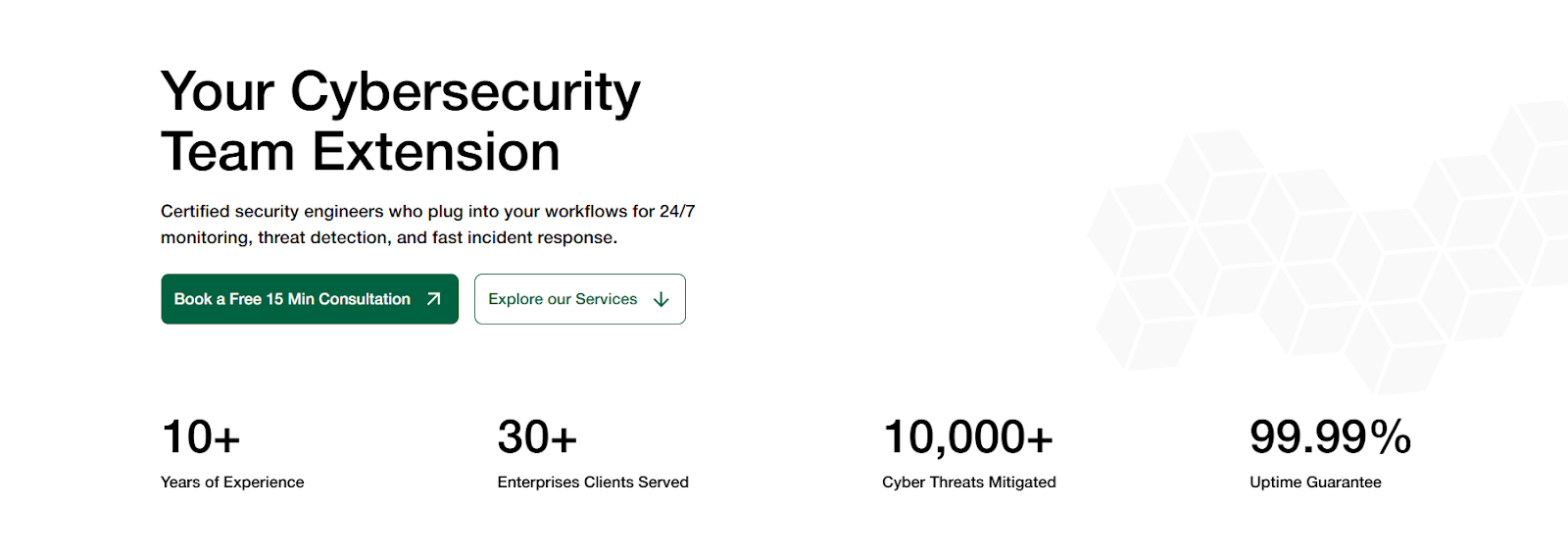
Best known for: The only published rate card in this comparison, paired with a 15-minute contractual response time.
Where they excel:
- Operates the Microsoft licences you already own instead of selling a parallel stack
- 15-minute response SLA, the fastest contractual commitment here
- Live in 72 hours via Azure Lighthouse, no agent migration
Where they fall short:
- Published rate requires 200 endpoints or 50 servers
- Founded 2024, no published compliance attestation
- Microsoft-first by design, so mixed estates need connectors
Ideal customer size: 200 to 500 employees, plus MSP partners.
Stack compatibility: Microsoft Sentinel, Defender XDR, Defender for Endpoint, Entra ID, Intune.
Pricing insight: Published. Watch from $3.12 and Defend from $4.80 per endpoint per month, no setup fees.
2. Sophos MDR
Best known for: Letting the buyer choose how much response authority to hand over.
Where they excel:
- Three named response modes: Notify Only, Collaborate, Authorize
- 60-minute SLA on 90% of High Severity cases
- Runs alongside an existing EDR via XDR Sensor
Where they fall short:
- MDR Essentials excludes full incident response and the breach warranty
- Own-site pricing is quote-only despite marketing simple pricing
- Full MDR pushes you toward the Sophos agent
Ideal customer size: SMB through mid-market.
Stack compatibility: Sophos agent, or third-party EDR, firewall, cloud and identity via XDR Sensor.
Pricing insight: Not published on sophos.com. AWS Marketplace lists $239.64 per workstation per year for fully managed MDR.
3. Red Canary
Best known for: Wrapping the tools you already run rather than replacing any of them.
Where they excel:
- EDR-agnostic across Defender for Endpoint, Falcon, SentinelOne, Carbon Black and Cortex
- 30-minute SLA from detection to notification
- Fastest onboarding here, because nothing gets ripped out
Where they fall short:
- You still pay for the underlying EDR separately
- No published pricing of any kind
- Hands-on response is an add-on, not the default
Ideal customer size: Mid-market to enterprise.
Stack compatibility: Major EDRs, cloud providers, identity platforms, SaaS.
Pricing insight: Not published.
4. CrowdStrike Falcon Complete
Best known for: Elite endpoint protection paired with fully managed remediation.
Where they excel:
- Containment executed on your behalf, not escalated to you
- High-fidelity alerts and strong identity threat detection
- Deep cloud and identity coverage
Where they fall short:
- Will not run alongside a competing EDR
- One of the two slowest onboarding paths here
- Managed service pricing is quote-only
Ideal customer size: Mid-market to global enterprise.
Stack compatibility: CrowdStrike suite, SIEMs, AWS, Azure, GCP.
Pricing insight: Not published. Platform tiers carry list prices; Falcon Complete is sales and channel only.
5. Arctic Wolf
Best known for: A named concierge analyst team on top of whatever you already run.
Where they excel:
- No new tooling required, ingests existing telemetry
- Agents, unlimited log retention and external scanning included in core MDR
- Does not bill on event or log volume
Where they fall short:
- Advises rather than acts, remediation stays with you
- Hands-on incident response needs a separate retainer
- No published rate despite a page named for predictable pricing
Ideal customer size: Mid-market to enterprise.
Stack compatibility: Broad, tool-agnostic across endpoint, network, cloud and identity.
Pricing insight: Not published. A UK G-Cloud reseller listing shows £8,298 per unit per year.
6. Rapid7
Best known for: Detection and unlimited incident response on a single contract.
Where they excel:
- Incident response included with no retainers, hourly fees or caps
- MDR and vulnerability management in one platform
- Asset-based pricing rather than data volume
Where they fall short:
- Requires the Insight Agent across the estate
- Asset counts are hard to compare against per-user quotes
- No published rate, every deal custom-quoted
Ideal customer size: Mid-market to enterprise.
Stack compatibility: Rapid7 Insight platform, cloud providers, major SIEMs.
Pricing insight: Not published.
7. Huntress
Best known for: Getting small teams with no security staff covered fast.
Where they excel:
- Deploys in as little as 30 minutes
- Manages Microsoft Defender Antivirus at no additional cost
- SOC investigates, contains and remediates on your behalf
Where they fall short:
- No published response SLA
- Cloud and identity coverage thinner than the endpoint story suggests
- Pricing deliberately withheld to protect partner margin
Ideal customer size: Small business through lower mid-market.
Stack compatibility: Huntress agent, Microsoft Defender for Endpoint, Microsoft 365.
Pricing insight: Not published.
8. Palo Alto Unit 42
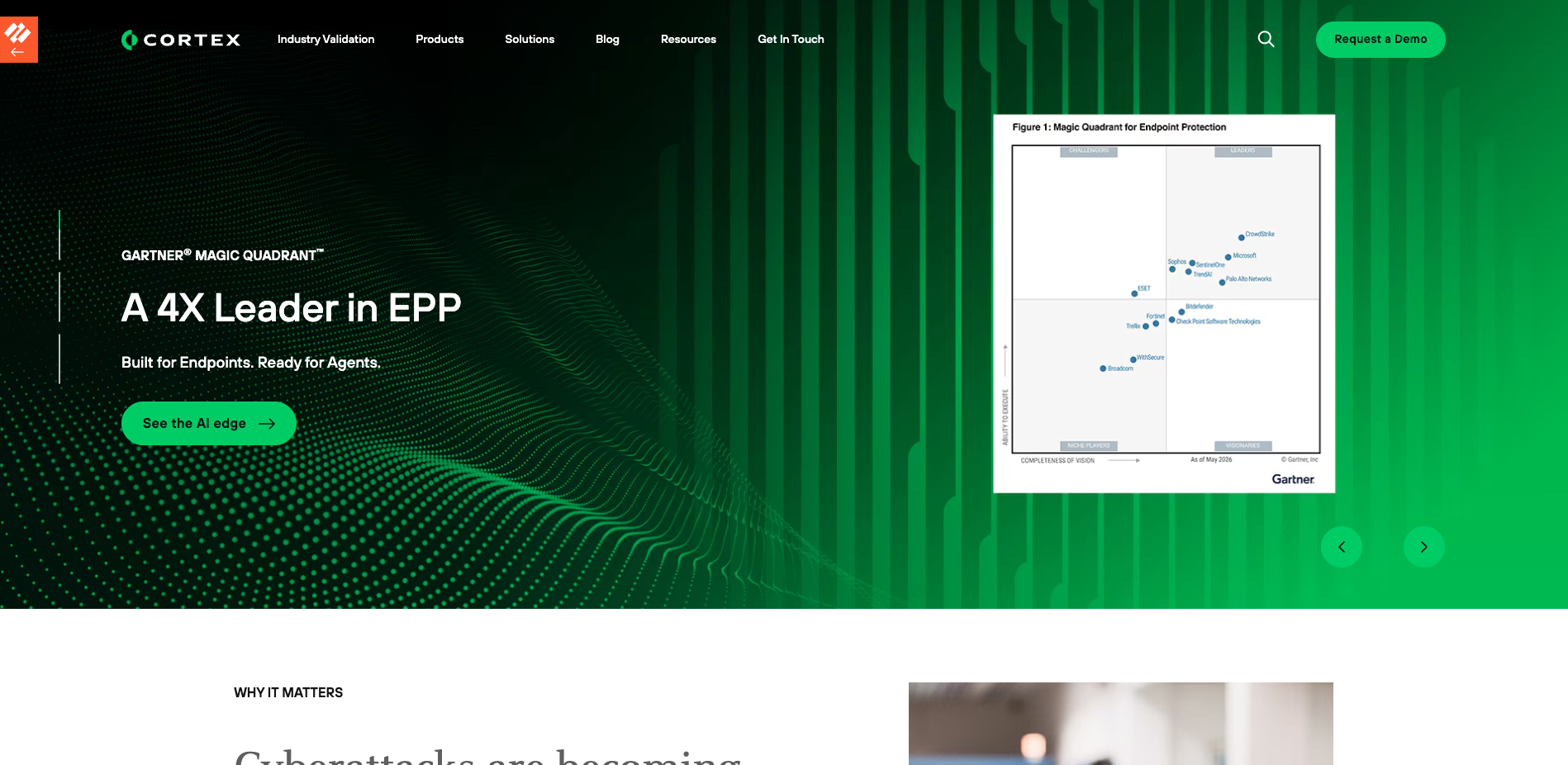
Best known for: Incident response depth backed by the Cortex platform.
Where they excel:
- Deepest cloud and identity coverage in this set
- Analysts isolate endpoints and remove malicious files directly
- Managed XSIAM adds SOC engineering in Pro and Premium tiers
Where they fall short:
- Requires Cortex XDR Pro or XSIAM
- Paid QuickStart engagement before monitoring begins
- Commits to a service-level objective, not an agreement
Ideal customer size: Upper mid-market to global enterprise.
Stack compatibility: Cortex XDR, Cortex XSIAM, Palo Alto network stack.
Pricing insight: Not published.
9. Blackpoint Cyber
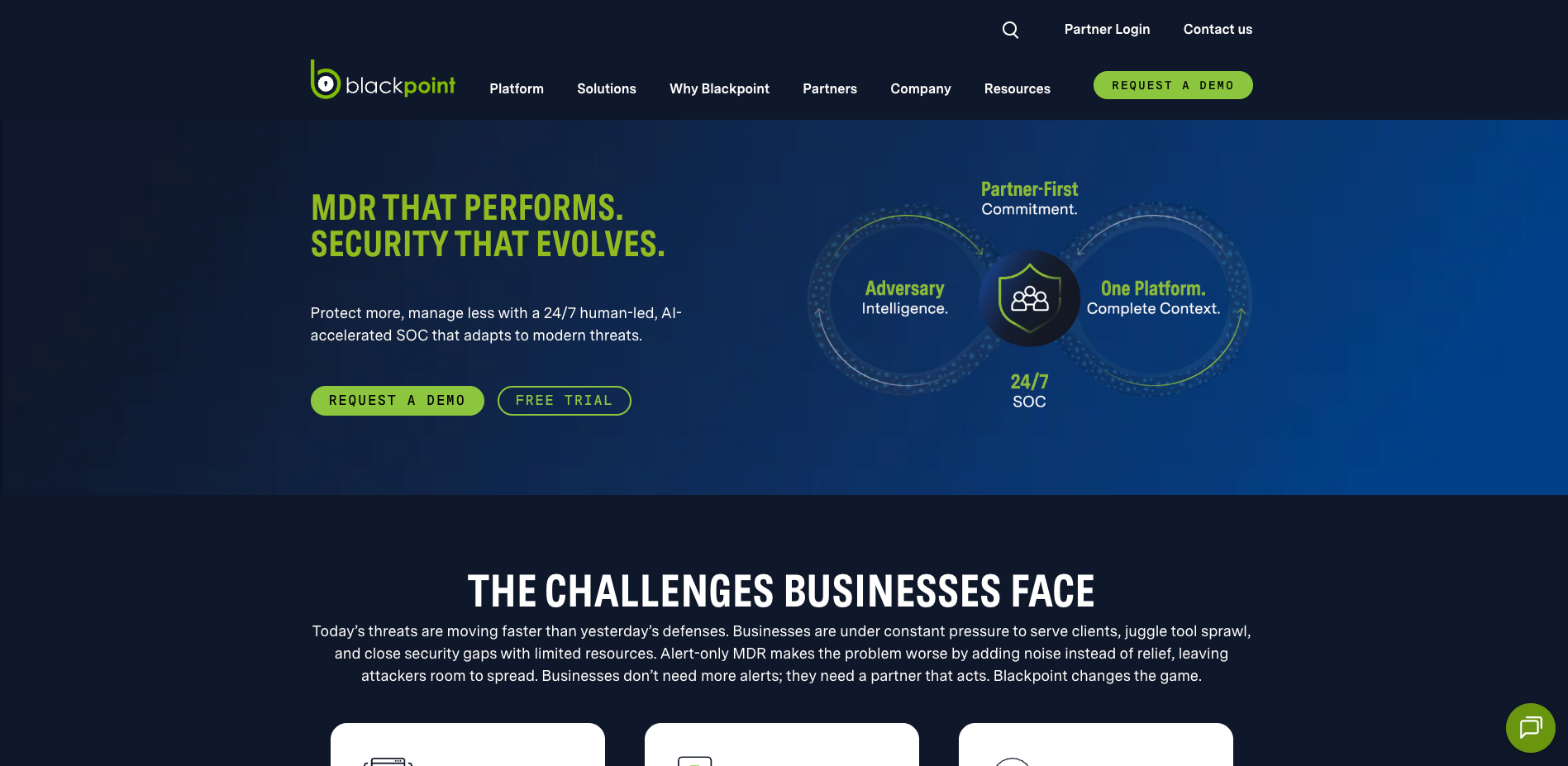
Best known for: Containing the threat first and telling you afterwards.
Where they excel:
- Autonomous isolation and process termination without waiting for approval
- Monitors Microsoft Defender Antivirus and steps in where it falls short
- Built specifically for SMB environments
Where they fall short:
- MSP channel only, you cannot buy direct
- No public contractual response time
- Cloud and identity coverage requires add-on products
Ideal customer size: Small business through mid-market, via an MSP.
Stack compatibility: Blackpoint agent, Microsoft Defender AV and Defender for Endpoint, Microsoft 365.
Pricing insight: Not published.
10. Microsoft Defender Experts for XDR
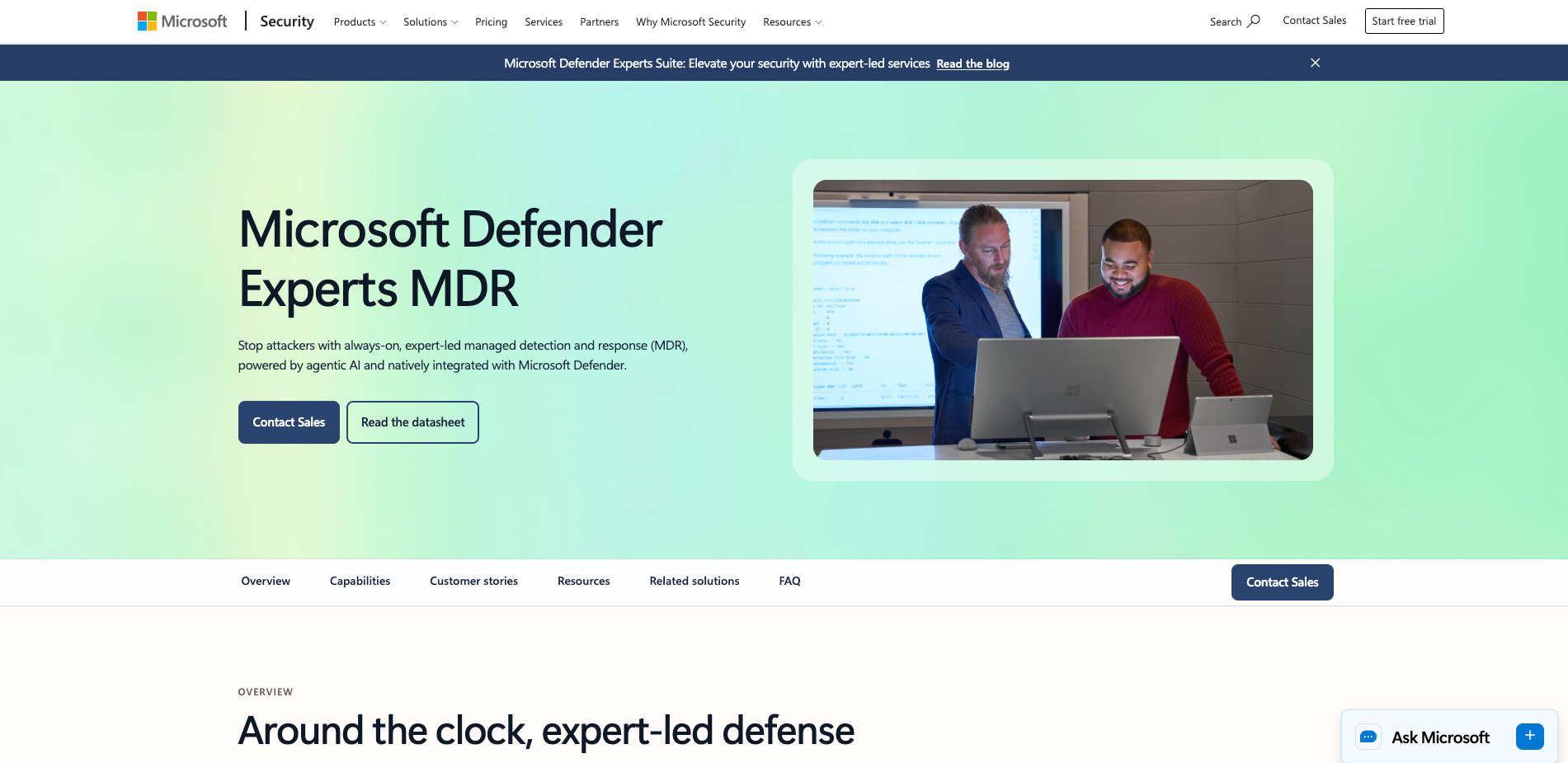
Best known for: Microsoft running its own stack for you.
Where they excel:
- Native to Defender XDR, no additional agent
- Covers High and Medium severity across Windows, Linux and macOS
- No third-party vendor in the data path
Where they fall short:
- Excludes iOS, Android, IoT, DLP and custom detections
- Requires Entra ID P1 for every user on top of the service
- No published price, interest form only
Ideal customer size: Mid-market to enterprise on Microsoft 365.
Stack compatibility: Microsoft Defender XDR, Defender for Endpoint, Entra ID.
Pricing insight: Not published.
What This Actually Costs
How to read a quote when nobody publishes a price
The only two rates in this market you can check without a sales call are $4.80 per endpoint per month from CyberQuell and $239.64 per workstation per year from Sophos on AWS Marketplace. Those are roughly $58 and $240 a year for the same category of service, and the gap is real rather than a discount, because they are not selling the same scope. Everything else arrives as a quote shaped around your headcount, which means the number you are given reflects what the vendor thinks you will pay. Treat the first quote as an opening position, ask for the per-unit rate in writing, and confirm whether the unit is a user, an endpoint or an asset before comparing anything.
Hidden fees to watch for
- Log ingestion charged by volume, which grows as you add cloud services
- Onboarding or professional services engagements billed before monitoring starts
- Incident response retainers sold separately from the monitoring contract
- Per-tenant charges on multi-tenant or multi-entity environments
- Underlying EDR or SIEM licences the MDR quote assumes you already hold
What is usually not included
- Remediation beyond containment, meaning rebuilds and restores stay with you
- Forensics and breach reporting for regulators or insurers
- Tuning and detection engineering for your custom applications
- Coverage for mobile, IoT and operational technology
- Vulnerability management and patching
Why the outsourced number looks high until you price the alternative. Continuous cover is 168 hours a week, and one analyst working 40 covers under a quarter of it, so a single person on shift at all times needs four to five full-time hires before you account for holiday, training, sickness and backfill. What it actually costs to run an internal SOC breaks the full load down.
What Are the Best Options for Outsourcing Cloud Security Operations and Threat Detection?
The best option is whichever provider already ingests your identity logs, because cloud coverage that stops at the endpoint is not cloud coverage.
What providers miss in multi-cloud environments
Most MDR services are endpoint-first, and cloud coverage is a later addition rather than the foundation. That matters because cloud attacks rarely touch an endpoint. A stolen token, an over-permissioned service principal, or a rule quietly added to a mailbox produce no process to terminate and no host to isolate. Signature-based tooling built for on-premises workloads has nothing to match against, so detection has to come from behaviour in the control plane instead. Ask which cloud log sources a provider ingests by name, not whether it covers cloud.
Log ingestion volume and what it costs you
Cloud telemetry is the one cost in this market that grows without you buying anything. Add a workload, turn on a new audit log, and ingestion rises. Providers that bill by data volume pass that straight through, which is why Arctic Wolf makes a point of not charging on event or log volume and Rapid7 prices per asset instead. Before signing, get the ingestion model in writing and ask what happens when volume doubles.
Who owns identity monitoring
Identity is where cloud coverage is genuinely tested, and it is the most common gap. Microsoft Defender Experts requires Entra ID P1 for every user before it monitors identity at all, which is a licensing cost on top of the service. Others treat identity as an integration you configure rather than something they own. The question to ask is direct: if a user's token is stolen at 2am, who disables the account, and do they need to call you first?
What This Looks Like in a Microsoft Environment
If you already hold Microsoft 365 E5 or Defender for Business, you own most of the detection layer. What you are buying from a provider is operations, not tooling, and that changes which of these ten make sense.
What comes native and what a provider adds
Microsoft Defender XDR correlates signals across endpoint, email, identity and cloud apps, and automated investigation and response (AIR) already remediates a share of them without a human. Microsoft Defender for Endpoint ships behavioral detections and one-click isolation. Entra ID flags risky sign-ins and impossible travel. Microsoft Sentinel gives you the SIEM, analytics rules and hunting queries. What none of it does is watch at 3am, tune out the false positives that make your team stop reading alerts, or decide whether an isolation is safe during your month-end close. That judgement is the actual purchase.
Who owns which workbook in a co-managed Sentinel deployment
The clean split is that you keep the tenant, the licences and the data, and the provider works inside them, typically through Azure Lighthouse so no credentials change hands. They own analytics rule tuning, the incident queue, and tier 1 and 2 triage. You own data connectors, retention policy, cost governance on ingestion, and the escalation path for anything touching production. Get that boundary written into the contract rather than agreed on a call, because it is where co-managed engagements fail.
Where the Microsoft-native path stops being enough
Three places, honestly. Coverage thins outside the Microsoft estate, so Linux servers, network appliances and non-Microsoft SaaS need connectors somebody has to build and maintain. Defender Experts, Microsoft's own managed service, excludes iOS, Android, IoT, DLP and custom detections, which tells you where the native ceiling sits. And Sentinel ingestion is consumption-priced, so a Microsoft-native SIEM is not automatically the cheap option as your log volume grows.
Where Managed SOC Actually Disappoints
Every provider on this page sells outsourcing, including us. These are the five ways it goes wrong, and they are worth knowing before you sign rather than in month four.
The five failure modes
- Context loss. An external analyst does not know that the finance server always spikes at month-end, so it gets escalated every month until someone tunes it out.
- Escalation friction. The provider finds it, then waits for you. If your after-hours contact is one person's mobile, you have outsourced detection but not response.
- Tuning debt. Detections drift as your environment changes. Without someone owning rule tuning by name, alert quality degrades quietly over 18 months.
- Business logic. No provider knows which of your applications can tolerate an endpoint being isolated mid-transaction. That judgement stays with you regardless of what the contract says.
- Containment authority. The most common gap between what buyers think they bought and what they got. Confirm in writing whether the SOC acts or asks.
None of these are reasons not to outsource. They are reasons to set the boundary explicitly in the contract, and most of them surface in the first 60 days of a managed SOC engagement.
Are You Ready to Outsource?
Score your current position
Answer yes or no. Count the yes answers.
- Someone is watching alerts between midnight and 6am, and it is not a phone that might be on silent.
- You know your current mean time to detect, as a number.
- Every endpoint, server and cloud workload is in an inventory somebody maintains.
- Someone owns detection rule tuning by name, and did some this quarter.
- Identity alerts from Entra ID or your IdP reach the same queue as endpoint alerts.
- You have a written escalation path that says who can authorise isolating a production machine.
- You have tested it, in the last twelve months, on something that was not real.
Seven questions to ask on the call
- Do you isolate endpoints without waiting for approval?
- What is your contractual response time, and what happens when you miss it?
- Which of my cloud and identity log sources do you ingest, by name?
- Is incident response included, or a separate retainer?
- Who tunes detections after onboarding, and how often?
- What is the per-unit rate, and is the unit a user, an endpoint or an asset?
- What is not covered at all?
Common Buyer Traps to Avoid
- Paying for SIEM and MSSP separately. Two contracts, two vendors, and the SIEM licence sits inside the MSSP quote anyway. MXDR covers both in one, and the saving is usually larger than the discount either vendor will offer you.
- Choosing on brand name rather than capability. The largest providers in this market are built for enterprise estates and price accordingly. A 120-person company gets better coverage from a provider whose smallest customer looks like them.
- Assuming the provider contains threats automatically. Providers differ more on this than on anything else. Arctic Wolf advises and leaves remediation with you, Sophos contains only if you select Authorize mode, and Microsoft acts alongside your team rather than independently. Detection without containment authority means somebody still has to wake up.
- Not clarifying what counts as an incident. Providers define severity differently, and severity determines what the SLA actually covers. Get the definition in writing, alongside how many incidents are included before overage applies.
- Low per-endpoint pricing with high add-ons. The headline rate covers monitoring. Incident response, cloud coverage, log retention and identity are frequently separate lines. Price the bundle you will actually need, not the entry tier.
Why CyberQuell Fits
If you already pay for Microsoft Sentinel and Defender, you have bought the detection layer twice over. CyberQuell operates the licences you hold rather than selling you a parallel stack, connected through Azure Lighthouse so no credentials change hands and no agent migration is required.
The rate card is published. Watch starts at $3.12 per endpoint per month and Defend at $4.80, with no setup fees and no markup on your Sentinel ingestion, which stays in your own tenant where you can see it. That is one of two rates in this entire comparison you can check without a sales call.
Defend contains and runs incident response end to end, backed by a 15-minute contractual response time. Only two other providers here publish a response time at all, and both are slower.
Final Thoughts
The providers on this page are all credible, and the scoring gap between first and tenth is smaller than it looks. What separates them is not detection quality, which is broadly comparable now, but two things a demo will not show you: whether the SOC acts at 3am or calls you, and whether you can find out what it costs without a sales cycle. Only three of the ten publish a contractual response time. Nine publish no rate at all.
So the decision in front of you is narrower than the market makes it feel. Score your own position first, because a provider cannot fix an asset inventory nobody maintains or an escalation path nobody has tested. Then ask the seven questions, get the per-unit rate in writing, and confirm what is excluded before you compare anything. If you already pay for Microsoft Sentinel and Defender, start by asking who could operate what you own rather than what you should buy instead.
If you want that answered against your actual environment rather than a table, book a call with CyberQuell and we will run the same five criteria across your current setup and tell you where the gaps are.
%20for%20Microsoft%20365%20(1).png)
.png)
.png)
